I’m just going to put it there and say this – If you can keep yourself healthy, functional, and unbroken for the next 20–30 years, you stand a real chance of living long enough to access therapies that extend your life beyond aging.
Not “slow down” aging. Not “age gracefully” (whatever the hell that means). Actually extend your life beyond it – where dying of old age becomes as archaic as dying of scurvy.
This isn’t sci-fi speculation or some biohacker’s fever dream. It’s the quiet consensus emerging from the world’s best-funded longevity labs, backed by Nobel laureates, billions in investment, and breakthroughs happening faster than most people realise.
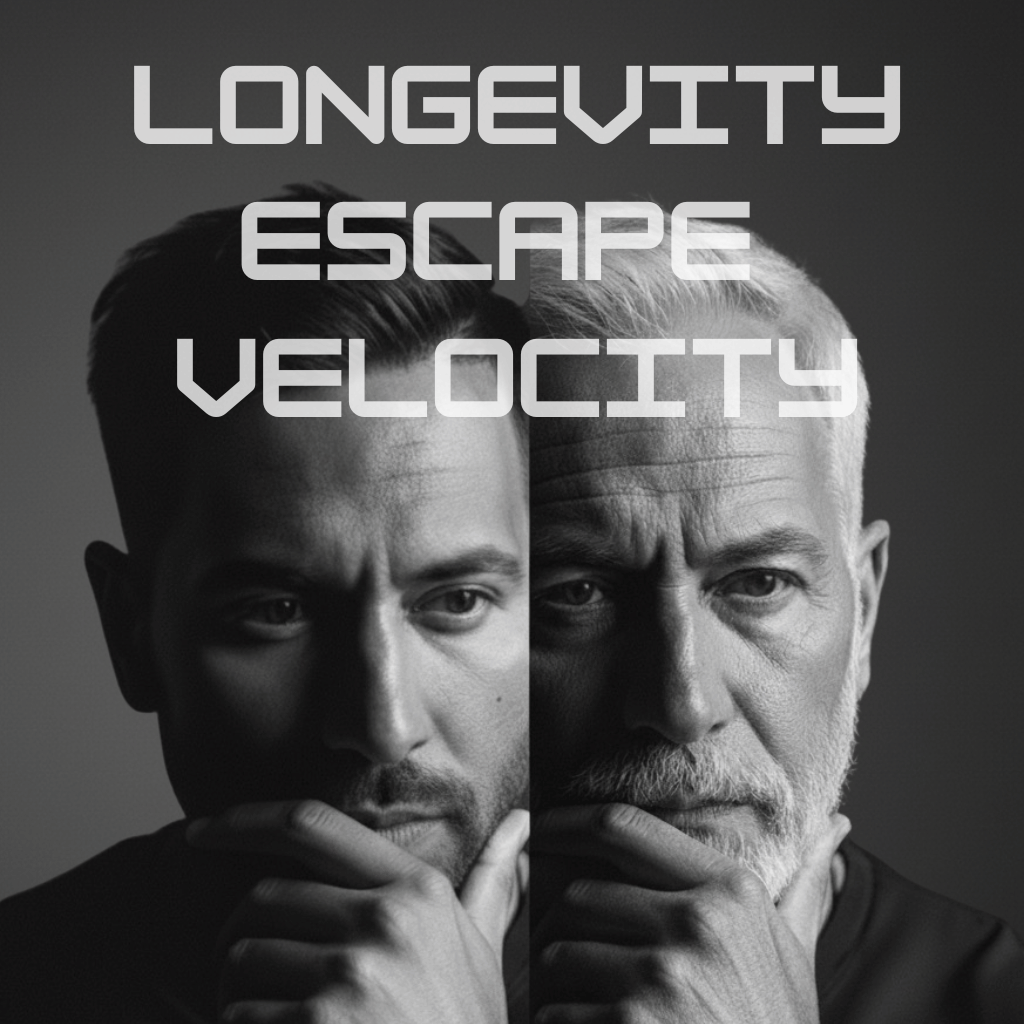
The concept is called longevity escape velocity – the point where each year you stay alive, medical science extends your expected lifespan by more than a year. If you can reach that inflection point, you’re no longer dying on schedule. You’re outrunning aging itself.
And we might be closer than you think.
When history looks back, it may see two revolutions converging – the birth of Super artificial intelligence, and the death of aging. The question isn’t whether they’ll arrive. It’s which one reaches us first, and whether you’ll still be around to benefit from it.
That thought crystallised for me the day I read a tweet from Derya Unutmaz, a respected immunologist who’s spent his career studying the immune system and infectious disease. Not your typical Silicon Valley “we’re gonna live forever, bro” type. His message was short, clinical, and devastatingly clear:
“AI will transform immunotherapy faster than any discovery in history.”
If AI could reprogram the immune system – the biological firewall that decides who lives and who doesn’t – then maybe it could do more than heal us. Maybe it could outpace death itself.
That was the moment I decided I wanted to be alive to find out.
The Human Experiment (Or: How I Became a Walking PubMed Subscription)
A few years ago, I turned myself into a project.
Not the kind you brag about on Instagram with motivational quotes over sunset photos—more of a private, slightly obsessive, data-driven rebellion against entropy.
I quit alcohol cold turkey. No “I’ll just have one on weekends” nonsense. Done.
Rebuilt my diet from the ground up—whole food, high protein, nothing beige or bubbly. If it came in a packet with more than five ingredients I couldn’t pronounce, it wasn’t going in my mouth.
Became a walking PubMed subscription, reading studies on sleep, supplementation, and cellular repair like some people binge Netflix. My friends thought I’d joined a cult. I kind of had.
Got myself a wearable (Oura Gen3 Ring) to track passively every data point on myself that I could afford.
The gym went from occasional guilt-trip to sacred appointment. Non-negotiable.
The results weren’t overnight -this isn’t a transformation story with dramatic before-and-after shots – but they were undeniable. I dropped over 15 kilos, brought my body fat down from 30 percent to 18 percent, Got myself the early 6-Pack and felt sharper, calmer, and absurdly more alive than I had in years.
And somewhere between deadlifts and discipline, I realised something quietly profound: most people don’t need to be immortal – they just need to stop dying quite so fast.
We spend decades accelerating our own decline through lifestyle, stress, and cheap dopamine hits, then call aging “natural.” Bollocks. It’s compounding neglect dressed up as inevitability.
Once you stop digging the hole, biology has an extraordinary ability to climb out of it.
That’s when longevity stopped being abstract science and became a lived philosophy. A decision to buy time.

From Sci-Fi to Funded Reality (Or: When Billionaires Start Taking You Seriously)
Twenty years ago, talking about “curing aging” got you laughed out of most conferences. Today, it gets you funded. Handsomely.
Names like Aubrey de Grey, David Sinclair, and Bryan Johnson have turned what was once fringe speculation into a legitimate, multi-billion-dollar research frontier. Companies like Altos Labs (backed by Jeff Bezos with $3 billion—yes, billion with a B), Calico Life Sciences (Google’s play), and a dozen well-funded startups aren’t dabbling—they’re hiring Nobel laureates to reverse the biology of aging.
When billionaires who could afford literally anything start throwing money at not dying, you know something’s shifted.
The premise is deceptively simple: aging isn’t mystical; it’s damage – molecular, cellular, systemic. If you can repair or reverse that damage faster than it accumulates, you don’t “stop aging”; you outrun it.
That’s longevity escape velocity – the point where each year you stay alive, science extends your expected lifespan by more than a year. Live long enough, and you’re no longer dying on schedule. You’ve escaped the gravity well.
The toolkit is already taking shape, and it’s genuinely wild:
Senolytics to clear zombie cells that poison surrounding tissue. In mice, this extended remaining lifespan by 36% and improved physical function. Human trials have started. We’re literally learning to take out the cellular rubbish.
Epigenetic reprogramming using Yamanaka factors to reset cells to a younger state. A recent gene therapy more than doubled remaining lifespan in elderly mice – they didn’t just live longer, they became biologically younger. Their organs worked better. They were less frail. Imagine hitting Ctrl+Z on your body.
CRISPR edits that repair genes like software patches, fixing DNA damage that accumulates with age. We’re debugging the human genome.
It’s messy, complex, and far from perfect – but the trajectory is unmistakable.
Still, there’s been a bottleneck: biology moves painfully slow. Discoveries that should take months can take decades, because every test has to be run on living systems, measured, and repeated.
Until now.
When AI Enters the Lab (And Everything Accelerates)
This is where Derya Unutmaz’s tweet starts to sound prophetic.
AI isn’t just automating spreadsheets or writing mediocre essays – it’s tearing through the walls of biological research like a caffeinated supercomputer with something to prove.
DeepMind’s AlphaFold solved one of biology’s grandest puzzles – predicting the 3D shape of every known protein – in under two years. A problem that would have taken human researchers centuries.
AI-powered drug discovery firms like Insilico Medicine and BioAge are designing and testing molecules in silico before a single pipette touches a petri dish. Insilico’s AI-designed drug for pulmonary fibrosis is already in human trials – and it reduces cellular senescence markers. An algorithm invented a drug. That actually works. On humans.
Machine learning models are analysing immune responses, identifying longevity biomarkers, and predicting how specific compounds will affect aging pathways faster than any human team could dream of.
To put it bluntly: AI is learning to read and write biology.
The same pattern-recognition engines that mastered chess and Go are now decoding the operating system of life. And when we cross into AGI – a system that truly understands biology rather than merely predicting it—we could see decades of biological progress compressed into years.
Imagine AI-controlled robotic labs that can design, test, and refine millions of potential rejuvenation therapies around the clock. No coffee breaks. No peer-review delays. No academic turf wars. Just perpetual iteration.
That’s when the line between longevity science and AI development disappears entirely – and the question isn’t if we’ll defeat aging, but how fast.

The Timeline (Or: How Long Do You Need to Not Die?)
Predictions in this space range from bold to biblical.
Ray Kurzweil – who’s been right about enough tech trends to be taken seriously – argues that by the late 2020s or early 2030s, we’ll reach the tipping point where life expectancy increases faster than time passes.
Aubrey de Grey gives it slightly longer, saying there’s a 50-50 chance we’ll hit escape velocity within 20 years.
Here’s the translation for ordinary mortals: if you’re reading this and can keep yourself healthy, functional, and unbroken for the next 20–30 years, you stand a real chance of living long enough to access therapies that extend your life beyond aging.
That doesn’t mean immortality -it means optional mortality. A world where dying of “old age” sounds as archaic as dying of scurvy or polio.
The catch? You have to get there first.
That’s why every healthy meal, every workout, every night of proper sleep isn’t just wellness – it’s strategy. It’s your ticket across the bridge to the next revolution.
No pressure. 🙂
The Uncomfortable Truth (That Should Bother You)
Here’s what no one wants to say out loud: if you die in the next 30 years, there’s a good chance it’ll be just a few decades before humanity figures out how not to.
That should bother you. It bothers me every time I think about it.
Because while Silicon Valley billionaires are pouring billions into longevity research for themselves, governments are still burning money on reactive healthcare – treating diseases one at a time instead of addressing the root cause.
We spend trillions managing the symptoms of aging while chronically underfunding the research that could eliminate it.
The NHS spends £120 billion a year keeping people alive in their final decades, most of it in the last year of life. Imagine if even 1% of that went into longevity research. We’d probably already be there.
But we’re not. Because the system isn’t designed to solve aging – it’s designed to manage decline and bill for it. There’s no profit in curing you once when they can treat you indefinitely.
That’s the quiet scandal no one’s talking about. We have the science. We have the toolkit. We have proof of concept in mice. What we don’t have is the urgency.
So while we wait for governments to catch up (don’t hold your breath), the only rational response is to take control of what you can: your own biology.
Treat your body like it matters. Because it might have to last a very, very long time.
What This Means for You (The Bit Where I Actually Help)
If this all sounds fantastical, remember how quickly technology compounds.
In 2007, the first iPhone launched. In 2012, CRISPR was discovered. In 2022, AI started writing poetry that didn’t completely suck. Today, it’s designing new proteins. Tomorrow, it might design new humans.
The biggest mistake people make is thinking progress is linear. It isn’t. It’s exponential – and most people only notice when it’s already happened.
So here’s your choice: you can dismiss this as sci-fi and continue treating your body like a rental car you’re planning to return damaged, or you can accept that we’re living through the most consequential biological moment in human history and act accordingly.
That doesn’t require a biohacking lab or a Silicon Valley budget. It requires discipline, consistency, and a longer time horizon than most people are comfortable with.
It means treating your body as a long-term asset, not a short-term convenience. Strength training, not just cardio. Sleep optimisation, not just “getting by on six hours.” Nutrition as fuel, not emotional pacification.
Stop drinking poison for fun. Stop eating rubbish because it’s convenient. Stop sacrificing your future self for present comfort.
Because whether it’s AI or biology that wins the race, one thing’s certain: the next few decades will redefine what being human actually means.
And if you’re not building the version of yourself capable of thriving in that world, you’re building an outdated model.

The Race Continues
Derya Unutmaz probably didn’t mean to send anyone into an existential tailspin with that tweet, but he did.
A scientist pointing out that AI will transform immunotherapy faster than any human discovery – that’s not a slogan, it’s a siren.
It made me realise we’re not watching separate revolutions. We’re watching intelligence and biology merge into one continuous feedback loop, and somewhere in that loop lies the end of aging.
I’m not betting on immortality. I’m betting on staying in the game long enough to see what happens next.
Because when history looks back, it may indeed see two revolutions- the birth of artificial intelligence, and the death of aging.
The only question left is: which one will reach us first?
And will you still be around to find out?
Want to stay ahead of the curve? I write about AI, longevity, and the future of work every week in my Sunday Blueprint newsletter. Real insights, zero hype, straight to your inbox. Subscribe here and join the conversation.
Next up: What happens to society – pensions, careers, relationships—when aging becomes optional? The social reckoning nobody’s prepared for.
Sources & Further Reading
This article draws on recent longevity research, clinical trials, and expert predictions. Key sources include:
Scientific Studies:
- Partial Reprogramming Extends Mouse Lifespan – Gene therapy using Yamanaka factors more than doubled remaining lifespan in elderly mice (2024)
- Senolytic Drugs Extend Lifespan by 36% – Dasatinib + quercetin trial results in old mice
- Epigenetic Age Reversal in Humans – TRIIM study showing 2.5-year reversal in biological age (2019)
Longevity Companies & Research:
- Altos Labs – $3 billion cellular reprogramming research backed by Jeff Bezos
- Calico Life Sciences – Google’s longevity research division
- SENS Research Foundation – Aubrey de Grey’s damage-repair approach to aging
AI in Drug Discovery:
- AlphaFold Protein Structure Breakthrough – DeepMind’s AI solving protein folding
- Insilico Medicine AI-Designed Drug – AI-discovered drug for pulmonary fibrosis in human trials
Expert Predictions & Analysis:
- Ray Kurzweil on Longevity Escape Velocity – Timeline predictions and AI acceleration
- Aubrey de Grey Interview – 50% chance of reaching LEV by 2036
- Economic Value of Aging Interventions – Nature Aging analysis: slowing aging worth $367 trillion globally
Market & Policy Analysis:
- Longevity Market Growth – PwC analysis of anti-aging therapeutics market
- Healthcare Cost Analysis – De Grey on economic imperative for universal access
All links verified and active as of October 2025. All opinions expressed are my own.

My Home Is On The News. Here’s What Actually Happens Next.
A Dubai resident runs the realistic scenario on what’s coming — not the dramatic version, not the reassuring one. Nine to eighteen months, the Strait, and why the city comes through it.

Nobody’s the Good Guy: AI, the Pentagon, and the Biggest Con of 2026
Anthropic got banned by the Pentagon. OpenAI swooped in. Both companies’ AI ended up in the same war. 2.5 million people switched apps thinking it mattered. It didn’t.

The Skill Problem Nobody’s Talking About (And Why Installing 500 of Them Is Making You Dumber)
Everyone’s installing hundreds of Claude Code skills thinking more is better. Here’s why 20 properly built skills will outperform 1,000 generic ones — and what actually works at production scale.