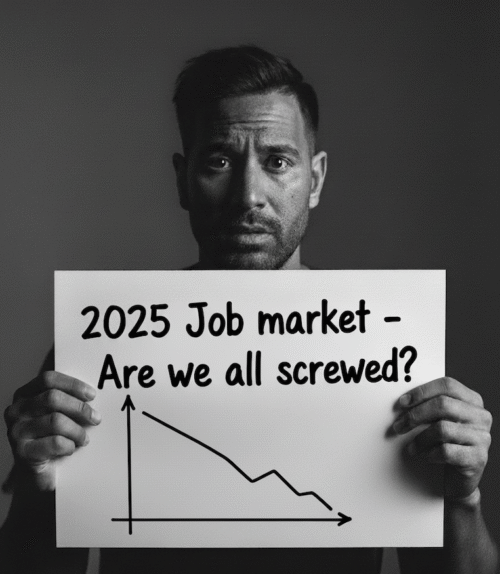
When a Microsoft Veteran Starts Driving a Taxi
Six months ago, a mate of mine finished his contract at Microsoft. Solid CV, years of experience, genuinely brilliant at what he does. The kind of person who should have recruiters queuing up.
He’s now driving a taxi to pay the bills.
Let that sink in for a moment. Someone who spent years working for one of the world’s biggest tech companies is now ferrying drunk people home at weekends because he can’t land another role in his field.
And here’s the kicker: he’s not alone. In the past month, at least fifty people in my network – most of them highly skilled tech professionals – have quietly asked if I knew of any openings. Fifty. That’s never happened before in my entire career.
Something has fundamentally shifted in the job market, and if you’re only reading the official statistics, you’d have no bloody clue it was happening. I had to get underneath the numbers and share my findings.
The Fairy Tale Version (That Nobody's Actually Living)
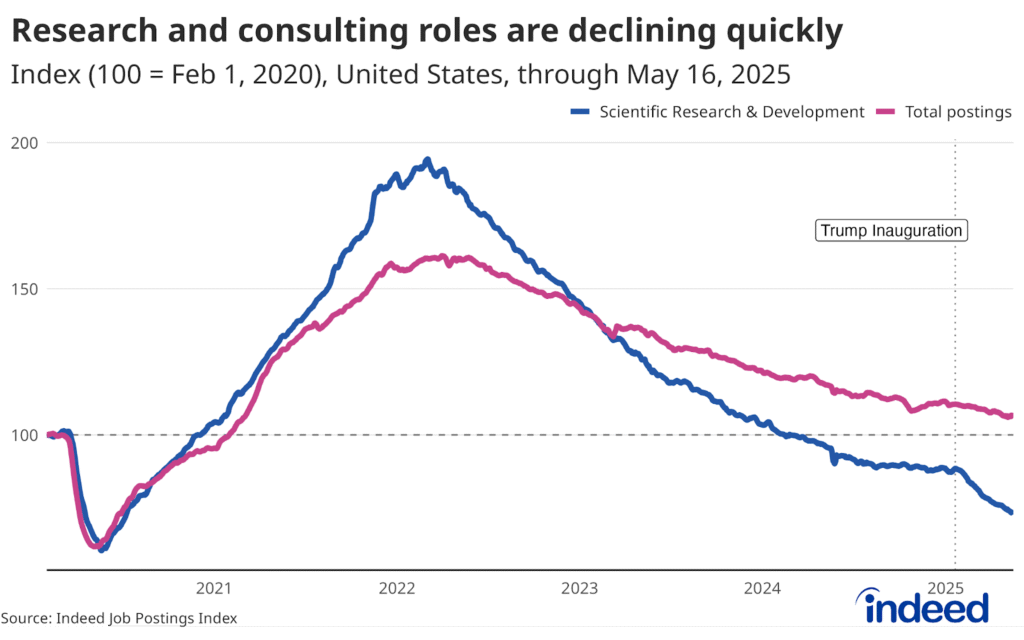
According to the International Labour Organization, global unemployment is sitting around 5%. If you skim the headlines, everything looks rather rosy. Economists use words like “resilient” and “stable.” Politicians congratulate themselves on managing the recovery beautifully.
Then you talk to actual human beings trying to find work, and it’s like they’re living in a completely different economy.
Hundreds of applications for single roles. Months-long searches that go nowhere. Job postings that mysteriously vanish or never get filled. Interview processes that drag on for twelve weeks and then… nothing.
We’re in one of those weird moments where the macro story the experts tell themselves bears absolutely no resemblance to the micro reality ordinary people are experiencing. And spoiler alert: it’s the micro reality that actually matters when you’re trying to pay your mortgage.
Here's something that should make you irrationally angry: according to a 2025 Greenhouse study, roughly 22% of job postings aren't real jobs at all.
Keith de Alwis Tweet
The Numbers They Don’t Want You Thinking About Too Hard
Let’s talk about what’s really happening beneath the glossy headlines:
Youth unemployment is at 12.6% globally – more than double the overall average. An entire generation is being told the system works while watching it fail them in real-time.
UK job vacancies dropped 35% year-on-year according to The Guardian. That’s not a blip.
That’s a collapse.
The average time to fill a role is now 37.3 days, which tells you companies are either being incredibly picky or have no idea what they actually want. Probably both.
Some roles are attracting 300-500 applications each. When five hundred people are fighting for one job, the selection process stops being about who’s best and starts being about who gets lucky.
And then there’s my personal favorite bit of corporate nonsense: ghost jobs.
Ghost Jobs: The Cruelest Joke in Hiring
Here’s something that should make you irrationally angry: according to a 2025 Greenhouse study, roughly 22% of job postings aren’t real jobs at all.
They’re what the industry politely calls “ghost jobs” – advertisements for positions companies have absolutely no intention of filling.
Why would they do this? Oh, let me count the ways:
- Building talent pipelines (translation: hoarding CVs for maybe later, maybe never)
- Looking like they’re growing (because nothing says success like fake job postings)
- Internal politics (someone approved headcount, but there’s no actual budget or buy-in)
- Keeping current employees nervous (nothing keeps people in line like the threat of replacement)
For job seekers, this is psychological torture. You spend hours tailoring applications, researching companies, preparing for interviews that will never happen – all for positions that were never real to begin with.
It’s like running a marathon where 22% of the finish lines don’t exist, and nobody tells you which ones are fake until you’ve already run the race.
If this doesn’t make you angry, you’re not paying attention.
AI: Villain, Scapegoat, or Both?
Everyone wants to talk about AI killing jobs, so let’s actually talk about it properly.
Yes, AI is changing the employment landscape. Companies are reporting 20% cost reductions through automation. Salesforce publicly announced they’re pausing junior engineering hires while they figure out how much AI can do instead. Roles involving repetitive, rules-based tasks are being swallowed faster than free food at a startup launch party.
But here’s what the panic merchants won’t tell you: AI isn’t the primary villain in this story.
Is it contributing? Absolutely. But it’s also become a convenient scapegoat for companies who were already planning to hire fewer people, pay them less, and squeeze more productivity out of smaller teams. “Sorry, had to let people go – it’s the AI revolution, you understand” sounds so much better than “We wanted better margins.”
The reality is more nuanced and, frankly, more interesting than the “robots are taking our jobs” narrative.
AI is phenomenally good at certain tasks. It’s rubbish at others. The future isn’t AI versus humans – it’s AI augmenting humans who know how to use it properly. Creativity, strategic thinking, emotional intelligence, complex judgment calls – these are still firmly in human territory.
The problem isn’t that AI is replacing everyone. The problem is that companies are using AI as an excuse to restructure roles, eliminate entry-level positions, and generally make the job market more hostile while blaming technology instead of taking responsibility for their choices.
The Skills Mismatch Nobody Wants to Fix
Here’s a particularly frustrating paradox: the 2025 World Economic Forum report found that 40% of employers can’t find the technical skills they need.
Meanwhile, millions of job seekers are being told they’re overqualified, underqualified, or just not quite the right fit – often for roles they could do brilliantly.
This isn’t a skills problem. It’s a matching problem, complicated by absurd hiring practices.
Companies want candidates with five years of experience in technologies that have existed for eighteen months. They want senior expertise at junior salaries. They want cultural fit, which often means they want clones of the people already there. They want someone who can start immediately but are happy to drag the hiring process out for three months while they “assess fit.”
And then they have the audacity to complain about skills gaps.
The jobs exist. The talent exists. But the two aren’t meeting because the entire hiring process has become a bureaucratic nightmare designed more to cover arses than to actually find good people.
The Psychological Toll (That Nobody Talks About)
Let’s talk about what this actually does to people, because that’s the bit that really matters.
Job searching has always been stressful. But the 2025 version is particularly brutal:
The rejection fatigue is real. When you know hundreds of others are competing for the same role, every rejection feels less personal but somehow more devastating. You’re not being rejected for who you are – you’re being rejected because the odds are mathematically impossible.
The self-doubt creeps in faster. After months of searching, even talented people start questioning everything. “Maybe I’m not as good as I thought. Maybe my experience doesn’t count anymore. Maybe I should have done that certification. Maybe I’m too old, too expensive, too whatever.”
The financial stress becomes unbearable. Savings drain faster than expected. The stopgap measures – Uber driving, freelance gigs, burning through networks for contract work – become the new normal. And all the while, you’re supposed to show up to interviews radiating confidence and enthusiasm.
This isn’t just about careers. It’s about mental health, family stability, and people’s fundamental sense of worth and capability.
And when someone like my Microsoft mate ends up driving a taxi despite years of valuable experience, it’s not a personal failure. It’s a system failure.
What’s Really Driving This Mess
AI gets all the headlines, but there are other forces at play that deserve equal attention:
Economic caution everywhere. Companies are sitting on cash, waiting for clarity that never comes. They’re using contractors instead of employees, temporary instead of permanent, anything to avoid commitment in uncertain times.
Global uncertainty is the new normal. Inflation, political instability, supply chain chaos, energy costs – pick your crisis. It all adds up to companies keeping their payrolls lean and their options open.
Remote work changed everything. It’s brilliant for flexibility, but it also means every job is now a global competition. That London tech role? You’re competing with someone in Portugal who’ll do it for 40% less and someone in India who’ll do it for 60% less. Geography used to be a moat. Now it’s irrelevant.
The VC money tap turned off. For years, startups hired aggressively on the promise of future funding. That funding has dried up, those companies are now cutting back, and all those people are flooding an already saturated market.
Put simply: demand for work hasn’t disappeared, but the supply of real opportunities has shrunk dramatically while competition has exploded exponentially.
It’s a perfect storm, and you’re sailing right through it.
Join Your Sunday Blueprint for AI, Automation & Side Business Success
The Sunday Blueprint
So What the Hell Do We Do About It?
Here’s where most career advice blogs would tell you to “stay positive” and “keep networking” as if those platitudes solve anything.
I’m not going to do that. Instead, I’m going to give you three different playbooks depending on where you are right now – because there isn’t one solution that fits everyone.
Playbook 1: You’re Out of Work and Need Something Fast
Your priority isn’t optimization – it’s survival. You need cash flow, and you need it quickly.
Stop Playing the Numbers Game
Sending out 200 generic applications isn’t working. It never did, but in this market it’s particularly useless. You’re competing with hundreds of others doing exactly the same thing.
Instead: Identify 15-20 companies that are actually, genuinely hiring (not ghost job hiring) and go deep. Research them properly. Understand their problems. Tailor every application to show you understand what they need and can deliver it.
Quality over quantity isn’t just good advice – it’s your only realistic shot.
Your Network Is Your Lifeline
I hate to be the bearer of obvious news, but referrals still beat job boards by a country mile. Someone vouching for you internally changes everything about how your application is seen.
Reach out to old colleagues, former managers, university friends, that person you met at a conference five years ago. Not with “can you get me a job?” but with “I’m exploring opportunities in X sector, and I’d love your perspective on where the interesting work is happening.”
People want to help, but they need to know you’re looking. Be specific about what you want and why you’d be good at it.
Be Open to Interim Everything
Freelance gigs, contract work, project-based roles – these aren’t failures, they’re bridges. They keep money flowing in, they keep your skills current, and they often convert to permanent positions when companies realize you’re valuable.
Plus, in a market where companies are commitment-phobic, being available for short-term work makes you less risky to hire.
Sharpen Your Pitch to Brutal Clarity
You’ve got about 30 seconds to make someone care about you. Most people waste it with generic statements about being a “passionate professional with strong communication skills.”
Instead, know exactly what problem you solve and for whom. “I help SaaS companies reduce churn by 15-20% through better onboarding” is infinitely more interesting than “experienced customer success manager.”
Be so clear about your value that a stranger could explain what you do after one conversation.
Stay Visible (Even When You Don’t Feel Like It)
I know you’re tired. I know the last thing you want to do is post on LinkedIn or attend networking events. But visibility creates serendipity, and serendipity creates opportunities.
Share one insight per week. Comment on industry posts. Reconnect with people through genuine messages. You’re not begging for work – you’re demonstrating expertise and staying present in people’s minds.
The person who gets the job often isn’t the best candidate. It’s the one someone remembered at the right moment.
Playbook 2: You’re Employed But Want Insurance
You’ve got stability for now, which means you have the luxury of preparation. Use it.
This is about building resilience so that if things turn (and in this market, they might), you’re not scrambling.
Future-Proof Your Skills Aggressively
The roles surviving automation aren’t the ones with the most technical skills – they’re the ones requiring creativity, strategic thinking, leadership, and complex judgment.
Invest time in learning where AI can’t reach. How to frame problems. How to lead teams through ambiguity. How to communicate complex ideas simply. How to spot opportunities others miss.
These are the skills that will keep you valuable regardless of what technology does next.
Save Like You Mean It
Aim for 6-12 months of living expenses in the bank. Yes, I know that’s hard. Yes, I know life is expensive. But that cushion is the difference between making good decisions and desperate ones.
Financial runway gives you the freedom to walk away from terrible opportunities and wait for good ones. It’s peace of mind that lets you sleep at night. Worth every penny.
Keep Your Assets Fresh
Don’t wait until you need a job to update your CV, LinkedIn, and portfolio. Do it quarterly as routine maintenance.
Treat your professional brand like a garden – it needs regular tending, not panic-driven overhauls when weeds have taken over.
Future you, facing an unexpected redundancy or amazing opportunity, will be incredibly grateful present you maintained this discipline.
Expand Your Network When You Don’t Need It
The best time to build relationships is when you’re not asking for anything. Attend industry events, mentor junior people, reconnect with old colleagues just to say hello.
Build genuine relationships based on mutual interest, not transactional necessity. Then when you do need help, you’re not that person who only shows up when they want something.
Experiment on the Side
Use your employment stability to test ideas without risk. Try consulting one day a month. Teach a course online. Build a small product. Write about your industry.
These experiments build optionality. Maybe they become income streams. Maybe they become full businesses. Maybe they just stay interesting hobbies. But they all expand what’s possible for you.
Playbook 3: You’re Ready to Build Something of Your Own
Uncertain markets are often the best time to start something new, but only if you’re smart about it.
The key is testing before fully committing – using the chaos as cover while you validate ideas without betting everything on them.
Start Lean and Stay Lean
Don’t build the perfect product or service. Build the smallest thing that solves a real problem for real people, then see if they’ll pay for it.
An MVP in 2025 can be built in weeks, not months. Use no-code tools, existing platforms, and automation to move fast without burning resources.
I’ve seen people waste years on products nobody wanted because they were too invested to pivot. Don’t be them.
Solve Pain, Not Passion
Everyone tells you to “follow your passion” as if that’s how successful businesses work. It’s not.
Successful businesses solve painful problems that people will pay to fix. Follow the complaints. Where are people frustrated? What’s costing them time or money? What existing solutions are terrible?
That’s where opportunity lives, regardless of whether you’re personally passionate about it. (Though if you can find overlap, brilliant.)
Use Existing Infrastructure
Don’t build from scratch what already exists. Shopify for e-commerce. Gumroad for digital products. Substack for newsletters. Teachable for courses.
These platforms handle the boring infrastructure so you can focus on the value you uniquely provide. Use them ruthlessly.
Your competitive advantage isn’t building better shopping carts – it’s solving problems in ways others haven’t thought of.
Timebox Your Experiments
Give each idea 90 days with clear success metrics. If it hits them, double down. If it doesn’t, kill it and move to the next idea.
Speed of learning is more valuable than persistence on bad ideas. The faster you can test and pivot, the faster you find what actually works.
Most people fail because they stick with losing ideas too long, not because they didn’t try hard enough.
Keep Your Day Job Until the Math Works
This might be controversial, but I genuinely believe the best entrepreneurship is boring entrepreneurship – where you keep stable income until your new venture proves it can replace it.
Stability first, scaling later. The pressure of needing your new business to work immediately often kills it. When you have runway, you make better decisions.
My startup that nearly broke me? That happened because I jumped before I’d validated demand. Don’t make my expensive mistakes.
The Opportunity Hidden in the Chaos
Here’s the truth most people don’t want to hear: difficult markets create the conditions for the biggest opportunities.
When the job market is friendly, everyone competes for the same safe paths. When it’s hostile, those safe paths disappear – which forces people to get creative, to build their own opportunities, to solve problems in new ways.
The professionals who emerge from this period will be more adaptable, more resourceful, and more resilient than any generation before them. They’ll have learned to create value in chaos, to spot opportunities others miss, to build their own security instead of relying on institutions that can’t provide it.
That Microsoft guy driving a taxi? I guarantee he’s learning things about himself, about business, and about resilience that he never would have learned in another corporate role. Not because driving a taxi is better than what he was doing – it isn’t. But because being forced outside your comfort zone teaches lessons nothing else can.
Think Jungle, Not Desert
The 2025 job market isn’t barren – it’s tangled. There’s growth happening everywhere, but it’s messy, competitive, and hard to navigate.
Yes, there are ghost jobs, AI disruption, and hundreds of applicants for every role. Yes, the traditional paths aren’t working like they used to. Yes, it’s frustrating and unfair and sometimes rage-inducing.
But there are also opportunities for those who adapt quickly, build diverse income streams, and stop waiting for the system to work the way it used to.
The system has changed. The question is whether you’ll change with it.
You can spend your energy being angry at how things should work, or you can spend it building alternatives that do work. Both responses are valid. Only one is useful.
So what’s it going to be?
Ready to Navigate This Mess?
The job market might be broken, but your career doesn’t have to be. Keep calm and take this on head first. Prepare for the worst and you might just future proof yourself through the disruption that is sure to come.
If you found this blog useful please sign up to my weekly newsletter (The Sunday Blueprint) for weekly insights on building freedom and resilience in a world that’s constantly changing. No corporate nonsense, just honest perspectives from someone navigating the same chaos you are.


My Home Is On The News. Here’s What Actually Happens Next.
A Dubai resident runs the realistic scenario on what’s coming — not the dramatic version, not the reassuring one. Nine to eighteen months, the Strait, and why the city comes through it.

Nobody’s the Good Guy: AI, the Pentagon, and the Biggest Con of 2026
Anthropic got banned by the Pentagon. OpenAI swooped in. Both companies’ AI ended up in the same war. 2.5 million people switched apps thinking it mattered. It didn’t.

The Skill Problem Nobody’s Talking About (And Why Installing 500 of Them Is Making You Dumber)
Everyone’s installing hundreds of Claude Code skills thinking more is better. Here’s why 20 properly built skills will outperform 1,000 generic ones — and what actually works at production scale.
Sources I used for this blog
International Labour Organization (ILO) – Global Employment Report 2024
Global unemployment and youth unemployment data.
https://www.ilo.org/global/about-the-ilo/newsroom/news/WCMS_910366/lang–en/index.htmThe Guardian – UK Labour Market Analysis 2025
Data on UK job vacancies dropping 35% and average time to fill a role.
https://www.theguardian.com/business/2025/feb/uk-job-vacancies-drop-unemploymentGreenhouse – Recruiting Trends Report 2025
Research estimating ~22% of job postings are ghost jobs.
https://www.greenhouse.com/blog/ghost-jobs-and-recruiting-trends-2025World Economic Forum – Future of Jobs Report 2025
Data on skills mismatch and 40% of employers struggling to find the right technical skills.
https://www.weforum.org/reports/future-of-jobs-report-2025Bloomberg Economics – Global Job Market Outlook 2025
Analysis on economic caution, hiring freezes, and AI-driven disruption.
https://www.bloomberg.com/economics/job-market-2025HR Dive – Candidate Experience Surveys 2025
Insights on high applicant volumes, rejection fatigue, and frustration in the job market.
https://www.hrdive.com/news/candidate-experience-report-2025LinkedIn – Workplace Trends 2025
Anecdotal surveys about job seeker frustration, longer searches, and networking importance.
https://www.linkedin.com/business/talent/blog/workplace-trends-2025