
AI consultants bridge the gap between bleeding-edge technology and messy business reality. The role pays $90K-$250K+ depending on experience, but success requires equal parts technical credibility, business savvy, and the ability to manage expectations when AI can’t solve everything.
- What AI Consultants Really Do (The Day-to-Day Reality)
- The Brutal Truth About Skills You Actually Need
- How to Actually Break Into AI Consulting
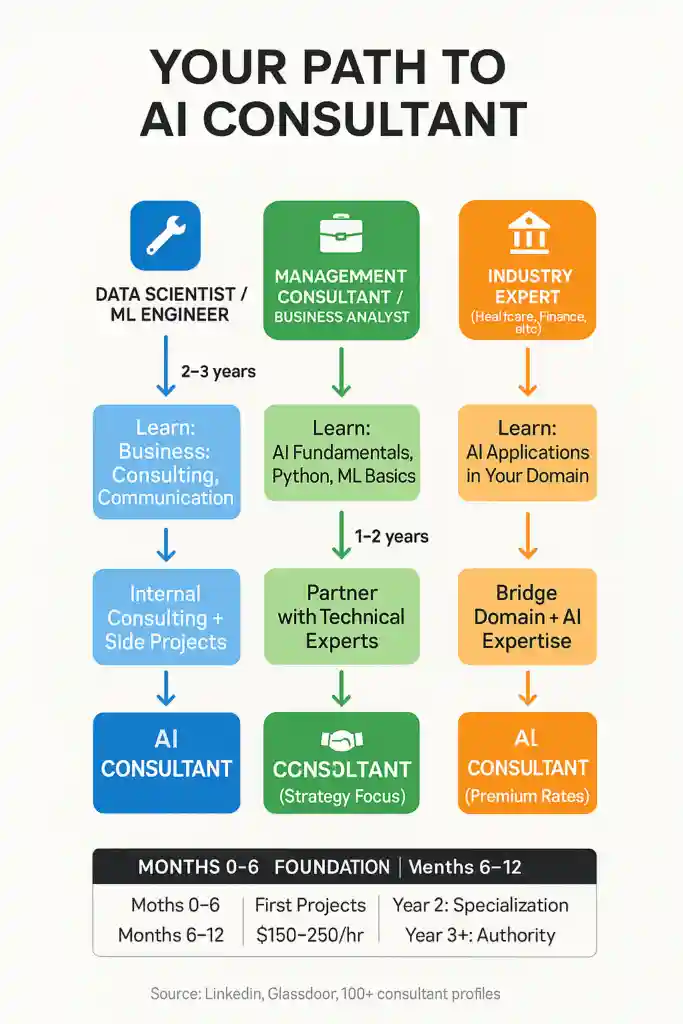
- Path 1: The Technical Background Route (Most Common)
- Path 2: The Business/Consulting Background Route (Increasingly Common)
- Path 3: The Domain Expert Route (Underrated)
- The First Client Problem (How to Actually Get One)
- The Skills Development Path (What to Learn When)
- What Nobody Tells You About the Transition
- What You'll Really Earn (And How to Charge)
- Real Projects: What Works vs. What Clients Ask For
- Project 1: The "We Need AI" Healthcare System
- Project 2: The E-commerce "Recommendation Engine"
- Project 3: The Manufacturing "Predictive Maintenance" Disaster
- Project 4: The Financial Services "Fraud Detection" Success
- Project 5: The Startup "Customer Churn Prediction" Pivot
- Common Patterns in Successful Projects
- The Types of Projects You'll Encounter
- Common Failures and How to Avoid Them
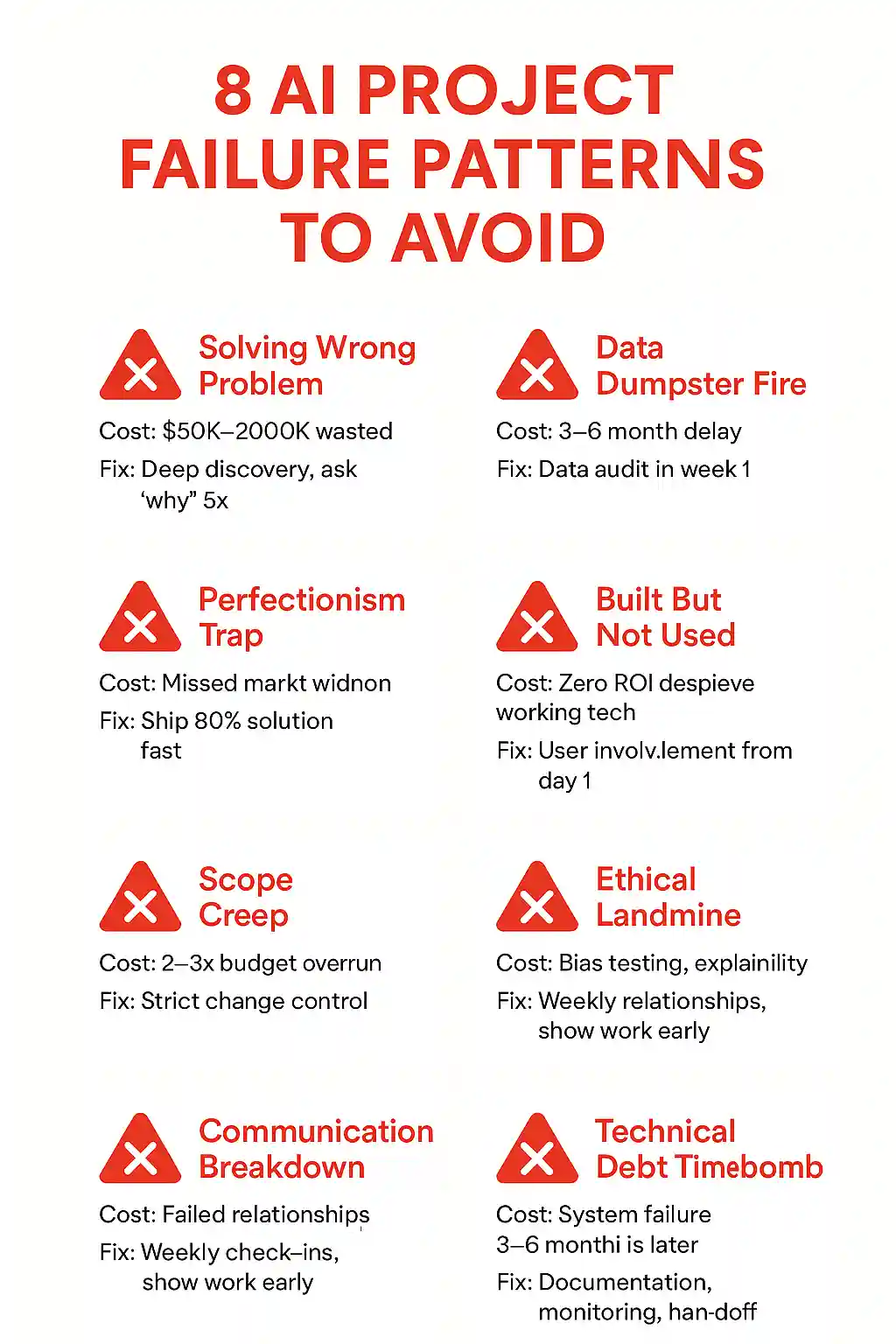
- Failure Pattern #1: Solving the Wrong Problem
- Failure Pattern #2: The Data Dumpster Fire
- Failure Pattern #3: The Perfectionism Trap
- Failure Pattern #4: The "Built It But Nobody Uses It" Catastrophe
- Failure Pattern #5: Scope Creep Death Spiral
- Failure Pattern #6: The Technical Debt Timebomb
- Failure Pattern #7: The Ethical Landmine
- Failure Pattern #8: The Communication Breakdown
- How to Recover from Failures
- Industry Demand and Career Outlook for AI Consultants
- Your Next Steps: The Action Plan
- If You're Just Starting (No AI Experience Yet)
- If You're a Technical Person (Data Scientist, ML Engineer, Software Developer)
- If You're a Business/Consulting Person (Consultant, Analyst, Product Manager)
- If You're a Domain Expert (Industry Specialist)
- Resources Worth Your Time
- The 90-Day Sprint to First Client
- The Long Game: Year 1-5
- When to Quit Your Day Job
- The Most Important Next Step
- Final Thoughts: Is This Career Right for You?
- Frequently Asked Questions
What AI Consultants Really Do (The Day-to-Day Reality)
Let me start with what most articles won’t tell you: about 60% of an AI consultant’s time is spent managing expectations, not implementing AI solutions.
An AI consultant is fundamentally a translator and strategist who helps organizations understand, adopt, and implement artificial intelligence in ways that actually create business value. But here’s the reality check – much of the work involves explaining what AI can’t do, not just what it can.
The Actual Job Breakdown
Based on analyzing typical project timelines, here’s how AI consultants actually spend their time:
Discovery and Scoping (25% of time)
- Interviewing stakeholders who often have unrealistic expectations from watching too many sci-fi movies.
- Auditing existing data infrastructure (usually discovering it’s a mess)
- Identifying use cases where AI might actually help versus where traditional automation would work better.
Strategy Development (20% of time)
- Creating roadmaps that balance ambition with technical reality.
- Estimating costs, timelines, and expected ROI.
- Presenting recommendations to executives who need to understand why this takes months, not weeks.
Technical Oversight (25% of time)
- Working with data science teams to ensure models align with business goals.
- Reviewing model performance and asking “so what?” until the metrics actually matter.
- Debugging why the AI that worked beautifully in testing fails spectacularly in production.
Change Management (20% of time)
- Training teams who are terrified AI will replace them.
- Building internal champions who can sustain the AI initiative after you leave,
- Handling the politics when AI exposes inefficiencies people wanted to keep hidden.
Project Management (10% of time)
- Keeping multiple stakeholders aligned
- Managing scope creep (everyone suddenly wants AI in their department).
- Explaining why the project is delayed when data quality issues emerge.
The Six Core Responsibilities (What You’re Really Paid For)
1. Reality-Checking AI Opportunities
Yes, you identify business needs. But more importantly, you identify when AI is not the answer.
I once had a client convinced they needed a sophisticated machine learning model for customer segmentation. After two days of discovery, I recommended a simple SQL query and saved them $150,000. They weren’t happy initially, but they’re now a loyal client who trusts me to tell them the truth.
Your job is to find the high-impact, feasible use cases – not just any use case where you could theoretically apply AI.
2. Developing Strategies That Survive Contact with Reality
Anyone can write a pretty AI strategy document. The art is creating one that:
- Accounts for the client’s actual (not claimed) data maturity
- Fits within realistic budget constraints
- Can be implemented by the talent they can actually hire
- Includes fallback options when the ambitious plan hits roadblocks
Your strategy document should have at least three scenarios: optimistic, realistic, and “things went sideways but we’re still getting value.”
3. Being the Translator Between Worlds
Data scientists speak in precision, recall, and F1 scores. Executives speak in ROI, market share, and competitive advantage. Your job is ensuring both groups actually communicate.
This means:
- Turning “we achieved 87% accuracy on the validation set” into “this will correctly identify 87 out of 100 potential fraud cases”.
- Explaining to data scientists why a 5% improvement matters when it translates to $2M in saved costs.
- Helping executives understand why they can’t just “add more AI” to make it better.
4. Validating Solutions in Business Terms
Technical success ≠ business success.
I’ve seen models with impressive accuracy metrics that were completely useless because:
- They were too slow for real-time decisions.
- Their predictions weren’t actionable (“this customer might churn” → okay, now what?).
- They required so much manual data preparation that humans could do the task faster.
Your validation checklist should include:
- Does this actually solve the business problem?
- Can the organization actually use these outputs?
- Is the accuracy improvement worth the implementation cost?
- What happens when this inevitably breaks in production?
5. Ensuring Ethical and Compliant AI
This isn’t just checking a box. In 2025, this is where lawsuits come from.
You need to verify:
- Bias testing: Does your model treat all groups fairly? (Spoiler: probably not in the first version).
- Explainability: Can you explain to a lawyer why the model made a specific decision?
- Data privacy: Are you compliant with GDPR, CCPA, and whatever new regulations just passed?
- Transparency: Can stakeholders understand what data is used and how?
Real example: A hiring AI I audited was systematically downranking candidates from certain zip codes. The model was “just finding patterns” in historical hiring data – which happened to encode decades of biased human decisions.
6. Driving Adoption (The Part Everyone Underestimates)
The graveyard of AI projects is filled with technically excellent models that nobody used.
Successful adoption requires:
- Champions: Find the person who’s excited about this and empower them
- Quick wins: Deliver something useful fast, even if it’s not the full vision
- Training: Not one-time presentations – ongoing support until it’s habit
- Feedback loops: Make it easy for users to report when AI does something weird
One manufacturing client had a predictive maintenance model with 90% accuracy that sat unused for six months. Why? Because the factory floor managers didn’t trust it and had no way to flag false positives. We added a simple feedback mechanism and usage jumped to 80% within weeks.
The Brutal Truth About Skills You Actually Need
Most skill lists for AI consultants read like a kitchen sink of every buzzword in tech and business. Let me tell you what actually matters, in order of importance.
1. The Ability to Ask “Why?” Until You Hit Bedrock (Most Critical)
This isn’t on any official skills list, but it’s the difference between good and great AI consultants.
When a client says “we need AI for customer service,” you need to dig:
- Why do you think AI will help?
- What’s wrong with your current customer service?
- What does success look like in numbers?
- Who’s going to use this AI system and what’s their current workflow?
- What have you already tried?
Most client requests are solutions disguised as problems. Your job is finding the actual problem.
2. Technical Literacy (Not Expertise)
Here’s a controversial take: You don’t need to be able to code production-quality models. You need to be able to:
Do need:
- Understand how different ML algorithms work conceptually.
- Read Python code and understand what it’s doing.
- Know when a data scientist is bullshitting you with technical jargon.
- Prototype simple models to test assumptions (regression, basic classification).
- Evaluate model metrics and understand their limitations.
- Know the difference between training, validation, and test sets.
- Understand data pipelines and why they break.
Don’t need:
- Optimize hyperparameters for state-of-the-art performance.
- Implement custom neural network architectures.
- Deploy models to production infrastructure.
- Fine-tune large language models from scratch.
Think of it this way: a film director doesn’t need to be the best cinematographer, but they need to know enough to evaluate cinematography.
3. Communication: The Skill That Determines Your Rates
The consultants making $500/hour vs. $150/hour often have similar technical skills. The difference is communication ability.
You need to master:
- Executive summaries: Busy execs need the answer in 3 sentences before they decide whether to read more
- Data storytelling: Turning analysis into narratives that drive decisions.
- Visualization: Making complex results immediately understandable.
- Saying no diplomatically: “That’s an interesting idea, but here’s why it won’t deliver ROI”.
- Managing up: Training your clients to give you what you need to succeed.
Pro tip: Record yourself explaining a technical concept. Watch it back. If you use more than one acronym per minute, you’re losing your audience.
4. Business Acumen (Understanding How Money Actually Works)
You need to understand:
- How the client makes money (revenue model).
- How the client loses money (cost structure).
- What metrics matter to executives (it’s never “model accuracy”).
- Basic project economics (ROI calculations, payback periods).
- Industry-specific constraints and opportunities.
Real example: I recommended a $200K AI investment that would save 1,000 hours/year of analyst time. The CFO killed it immediately. Why? Those analysts were already salaried and had capacity for this work. Zero actual savings.
If I’d understood their cost structure, I would have positioned it differently: “This frees up 1,000 analyst hours to focus on revenue-generating analysis that could increase sales by 5%.”
5. Project Management (Herding Very Smart Cats)
AI projects are uniquely messy because:
- Requirements are often unclear at the start.
- Technical feasibility is uncertain until you try.
- Success metrics evolve as stakeholders learn what’s possible.
- Data problems emerge late and delay everything.
You need to be comfortable with:
- Agile/iterative methodologies (waterfall AI projects always fail).
- Managing multiple stakeholders with competing priorities.
- Setting and resetting expectations when reality intervenes.
- Creating buffers for the inevitable “discovering our data is garbage” phase.
6. Domain Knowledge (The Competitive Advantage)
Generic AI consultants are commoditizing. Specialists command premiums.
After you’ve done a few projects, specialize:
- Healthcare AI: HIPAA, clinical workflows, FDA regulations for medical AI.
- Financial services: Regulatory compliance, risk management, fraud detection.
- Retail/E-commerce: Supply chain, personalization, demand forecasting.
- Manufacturing: Predictive maintenance, quality control, process optimization.
Domain expertise means you:
- Recognize patterns across clients in the same industry.
- Know industry-specific regulations and constraints.
- Speak the client’s language (not generic business speak).
- Build a network for referrals within that industry.
The Skills That Matter Less Than You Think
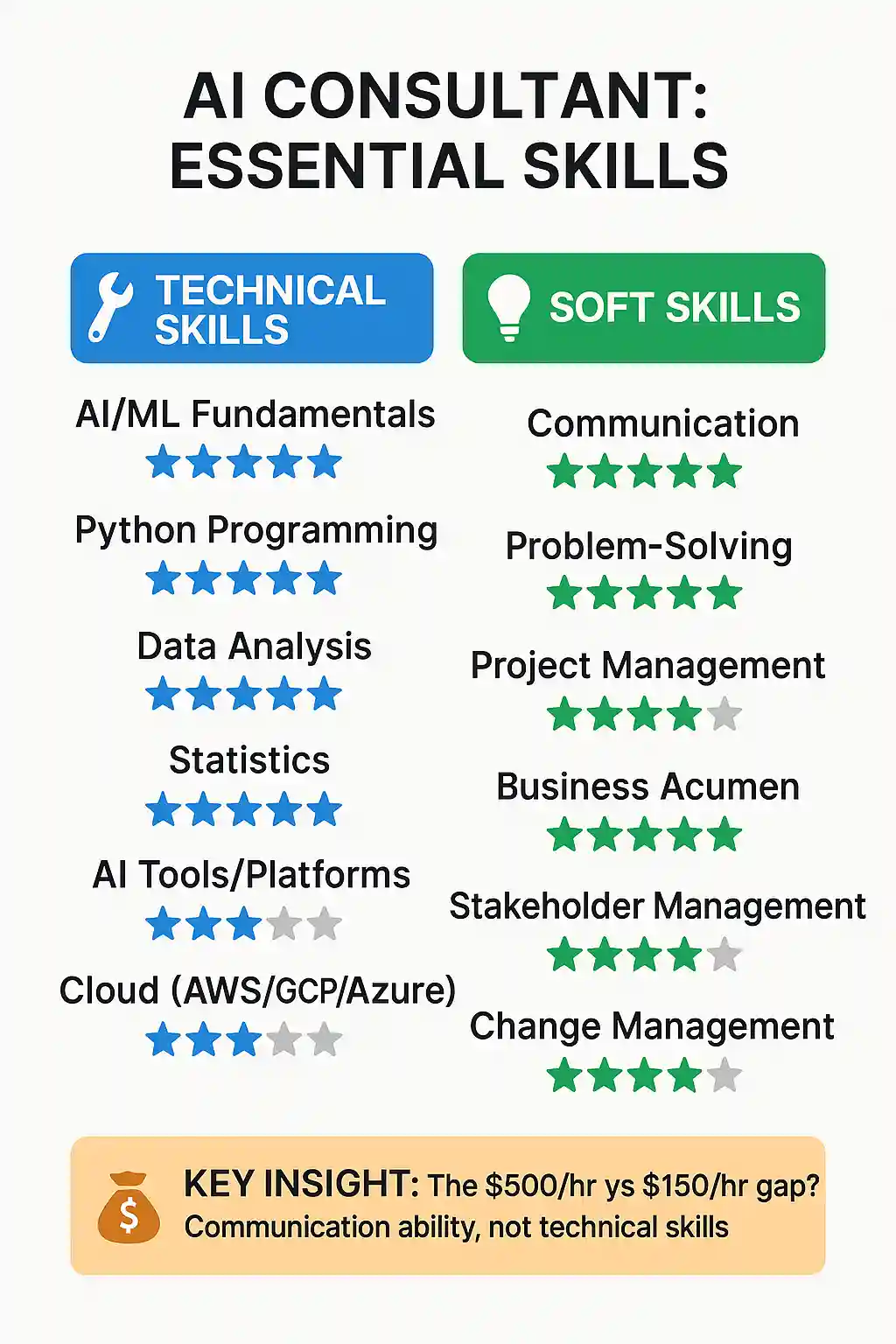
Advanced mathematics: You need statistics fundamentals, but you don’t need to derive backpropagation by hand. If you can understand what a confusion matrix tells you and why correlation isn’t causation, you’re 90% there.
Every AI framework: Don’t try to master TensorFlow, PyTorch, scikit-learn, and every new framework. Understand what each is good for and when to use which.
Certifications: They help early in your career for credibility, but after your first few successful projects, nobody cares. Your portfolio matters more than your certificates.
The Soft Skills Nobody Tells You About
Comfort with ambiguity: Half your projects will start with “we want AI for… something” and you need to be okay with that.
Emotional intelligence: You’re often the bearer of bad news (“your data isn’t ready for AI” or “this project won’t deliver the ROI you expected”). How you deliver that news determines whether you get fired or trusted more.
Stakeholder management: AI projects touch multiple departments. You’ll navigate politics between data teams and business teams, between executives with competing priorities, between people who want AI and people who fear it.
Continuous learning: The field changes fast. What works today might be obsolete in 18 months. You need to genuinely enjoy learning, or you’ll burn out.
How to Actually Break Into AI Consulting
Let me give you the real paths people take, not the sanitized “follow these 5 steps” bullshit.
Path 1: The Technical Background Route (Most Common)
Starting point: You’re a data scientist, ML engineer, or software developer working on AI projects.
Transition strategy:
- Start consulting internally first: Volunteer to help other teams understand AI. This builds your communication muscles without the pressure of external clients.
- Document everything: Turn every project into a case study. Even if you can’t share client names, you can share “Reduced customer churn by 23% for a SaaS company using predictive modeling.”
- Move toward client-facing roles: Solutions engineer, technical account manager, or pre-sales support. These roles teach you client communication while leveraging your technical background.
- Take on your first consulting gig while employed: Moonlight on a small project (with your employer’s permission) or help a nonprofit. The first one will be awkward – that’s normal.
- Build your positioning: Don’t be a “generalist AI consultant.” Be the “AI consultant for healthcare providers” or “ML engineer who helps SaaS companies with churn prediction.”
Timeline: 2-3 years from technical role to full-time consulting if you’re intentional about it.
Pros: Strong technical credibility, can audit other people’s work, command higher rates.
Cons: Need to learn business and communication skills that don’t come naturally to many engineers.
Path 2: The Business/Consulting Background Route (Increasingly Common)
Starting point: You’re a management consultant, business analyst, or domain expert who wants to specialize in AI.
Transition strategy:
- Get technical fundamentals: Take courses like Andrew Ng’s Machine Learning or Fast.ai. You don’t need a CS degree, but you need to understand how AI actually works.
- Partner with technical people initially: For your first few projects, work with a data scientist who can handle implementation while you handle strategy and client management.
- Focus on AI strategy consulting: Help companies understand where to apply AI, not how to implement it technically. This is valuable and plays to your strengths.
- Learn by doing small projects: Kaggle competitions, personal projects analyzing public datasets, building simple models to understand the process.
- Position as a “strategy-first” AI consultant: Your value is translating business needs into AI opportunities and managing the people side of AI transformation.
Timeline: 1-2 years to become credible if you already have consulting experience.
Pros: Already know how to consult, understand business, can command strategy-level rates.
Cons: Will always need to partner with or hire technical talent for implementation; less credibility for hands-on technical work.
Path 3: The Domain Expert Route (Underrated)
Starting point: You’re an expert in an industry (healthcare, finance, supply chain) who sees AI opportunities.
Transition strategy:
- Learn AI fundamentals for your domain: Don’t try to learn everything – focus on the AI applications most relevant to your industry.
- Become the bridge: You understand both the domain and AI, which is rare and valuable. Position yourself as the person who can identify where AI solves real problems in your industry.
- Start with process consulting: Help companies prepare for AI by fixing their data, processes, and organizational readiness. Most aren’t ready for AI anyway.
- Build a network of technical partners: You bring the projects and domain expertise; they handle the technical implementation.
- Write and speak: Share your insights about AI in your industry. This builds your brand as the go-to person.
Timeline: Variable, but you can start adding value immediately by helping companies understand AI in your domain context.
Pros: Deepest industry understanding, can spot non-obvious opportunities, command premium rates in your vertical.
Cons: Limited to one industry (which is also a strength), need to stay technical enough to be credible.
The First Client Problem (How to Actually Get One)
Everyone struggles with this. Here’s what actually works:
For your first 1-3 clients:
- Leverage your network ruthlessly: Tell everyone you’re doing AI consulting. Your second-degree connections know companies with AI needs.
- Do one project at a discount (not free): Charge 50% of your target rate to build a case study. Free projects get deprioritized by clients.
- Target small-to-medium businesses: Large enterprises have procurement processes that take months. SMBs can hire you in a week.
- Solve a specific, painful problem: Don’t pitch “AI transformation.” Pitch “I can help you automate 80% of your customer support tickets using AI, reducing response time from 4 hours to 15 minutes.”
- Create content showing your expertise: Write detailed articles, create tutorials, analyze public datasets in your target industry.
Where to find opportunities:
- LinkedIn: Share insights, engage with posts, message people solving AI problems.
- Industry conferences: The networking is worth more than the talks.
- Upwork/Toptal: Yes, really. Start here to build initial case studies.
- Your current employer: Many consulting careers start with “I’m leaving to consult, can I work on this project as my first client?”
Red flags to avoid:
- Clients who want to “pick your brain” for free.
- Projects with no clear success metrics.
- Clients who think AI is magic and won’t listen to reality.
- Scope that’s too large for a first project (start small).
The Skills Development Path (What to Learn When)
Months 0-6: Foundations
- Take Andrew Ng’s Machine Learning course and actually do the exercises.
- Learn Python and pandas well enough to analyze data.
- Build 3-5 small projects you can show (even if they’re on public datasets).
- Start writing about what you’re learning.
Months 6-12: Application
- Take on your first paid project (even if it’s small).
- Learn one AI domain deeply (NLP, computer vision, or recommendation systems).
- Study failed AI projects to understand what goes wrong.
- Start networking intentionally (conferences, LinkedIn, local meetups).
Months 12-24: Specialization
- Pick your niche (industry or problem type).
- Build 5-10 case studies.
- Increase your rates as you prove value.
- Create content that demonstrates expertise in your niche.
Years 2+: Authority Building
- Speak at conferences.
- Write detailed case studies or a book.
- Build partnerships with complementary consultants.
- Consider whether you want to scale (build a firm) or stay independent.
What Nobody Tells You About the Transition
It’s lonely: You go from being part of a team to figuring everything out yourself. Join communities, find mentors, get a business coach.
Feast or famine is real: Some months you’ll have more work than you can handle. Others you’ll have nothing. Build a cash buffer of at least 6 months expenses.
Imposter syndrome hits differently: When you’re consulting, there’s no one to validate your decisions. You need to trust yourself while staying humble enough to learn.
Sales is 30% of the job: Even the best consultant needs clients. If you hate sales, partner with someone who’s good at it.
You’ll undercharge initially: Everyone does. Your rate should increase 20-30% each year for the first few years as you build expertise and confidence.
What You’ll Really Earn (And How to Charge)
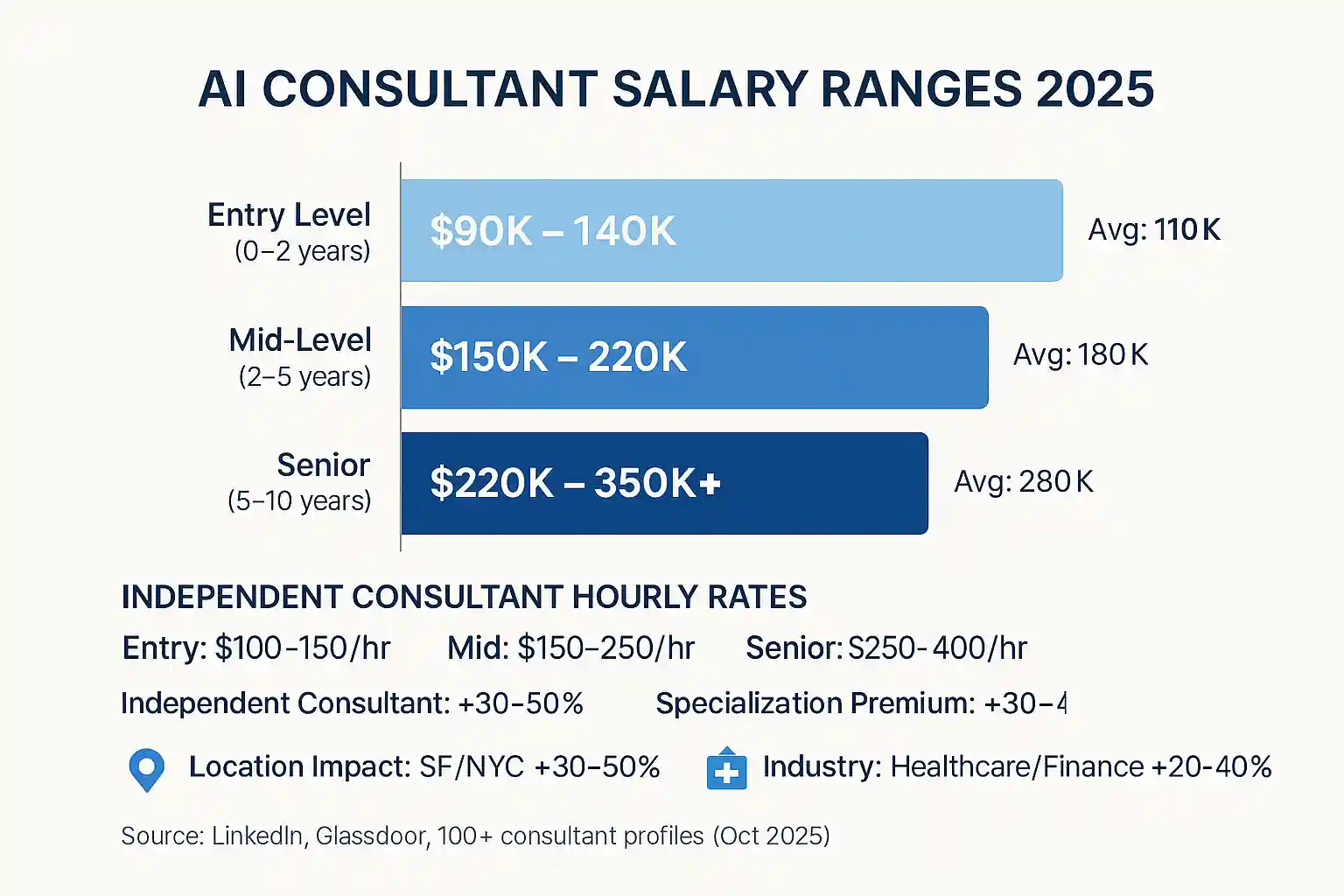
Let’s talk about money honestly, because most articles just give you a salary range and call it a day.
Salary Ranges (Employment)
Entry Level (0-2 years experience)
- At consulting firms: $90,000 – $120,000.
- At tech companies: $100,000 – $140,000.
- At traditional corporations: $80,000 – $110,000.
Reality check: “Entry level” usually means you have 2-3 years of data science or relevant technical experience plus an advanced degree. True beginners start as analysts or junior data scientists.
Mid-Level (2-5 years experience)
- At consulting firms: $120,000 – $180,000.
- At tech companies: $150,000 – $220,000.
- At traditional corporations: $110,000 – $160,000.
This is where specialization starts paying off. Healthcare AI consultants often earn 20-30% more than generalists at this level.
Senior Level (5-10 years experience)
- At consulting firms: $180,000 – $280,000.
- At tech companies: $220,000 – $350,000+.
- At traditional corporations: $160,000 – $240,000.
At this level, you’re typically leading multiple projects, mentoring junior consultants, and involved in business development.
Partner/Principal (10+ years, or exceptional 7+ years)
- At consulting firms: $300,000 – $800,000+ (often including profit sharing).
- Starting your own firm: $200,000 – $1,000,000+ (highly variable based on clients and rates).
Independent Consulting Rates
This is where it gets interesting. Independent consultants typically earn more per hour but have to handle their own sales, marketing, and admin.
Typical Hourly Rates:
- Beginner (with 2-3 years technical experience): $100 – $150/hour
- Intermediate (3-5 years, some consulting experience): $150 – $250/hour
- Advanced (5-8 years, strong track record): $250 – $400/hour
- Expert (8+ years, recognized specialist): $400 – $800/hour
- Top-tier (recognized thought leader): $800 – $1,500/hour
Reality checks:
- Geographic location matters: Subtract 20-40% if you’re not in a major tech hub or serving enterprise clients.
- Industry matters: Finance and healthcare pay premium rates; nonprofits and startups pay less.
- You won’t bill 40 hours/week: Count on 50-60% utilization (20-25 billable hours per week) when factoring sales, admin, and downtime.
Project-Based Pricing (Usually Better)
Most experienced consultants move to project-based or value-based pricing because it:
- Captures value better than hourly billing
- Avoids the “hourly rate negotiation” dance
- Rewards efficiency (finish faster, earn more per hour)
- Makes budgeting easier for clients
Typical Project Sizes:
Small projects (4-8 weeks):
- AI readiness assessment: $15,000 – $40,000
- Proof of concept development: $25,000 – $60,000
- Strategy workshop and roadmap: $20,000 – $50,000
Medium projects (2-4 months):
- End-to-end AI implementation: $60,000 – $150,000
- AI strategy and pilot: $50,000 – $120,000
- Model development and deployment: $80,000 – $200,000
Large projects (4-12 months):
- Full AI transformation: $200,000 – $800,000+
- Enterprise-wide AI strategy implementation: $300,000 – $1,500,000+
- Complex multi-phase initiatives: $500,000 – $3,000,000+
Partnership/Revenue Share: Some consultants take equity or revenue share for startups, typically:
- 2-5% equity for being a founding AI technical advisor.
- 10-20% of AI-driven revenue increase for performance-based deals.
- Hybrid: Reduced rate + success fee.
How to Actually Price Your Services
The Biggest Mistake: Pricing based on what you think you’re worth rather than the value you create.
Better Approach:
- Calculate the value created: If your AI solution saves $500K/year, you can charge $100-200K
- Anchor to client budget: Ask “What’s your budget for this?” before proposing a price
- Use market rates as a floor: Don’t charge less than market unless you’re deliberately buying experience
- Test pricing: If everyone says yes immediately, you’re charging too little
Pricing Strategy by Career Stage:
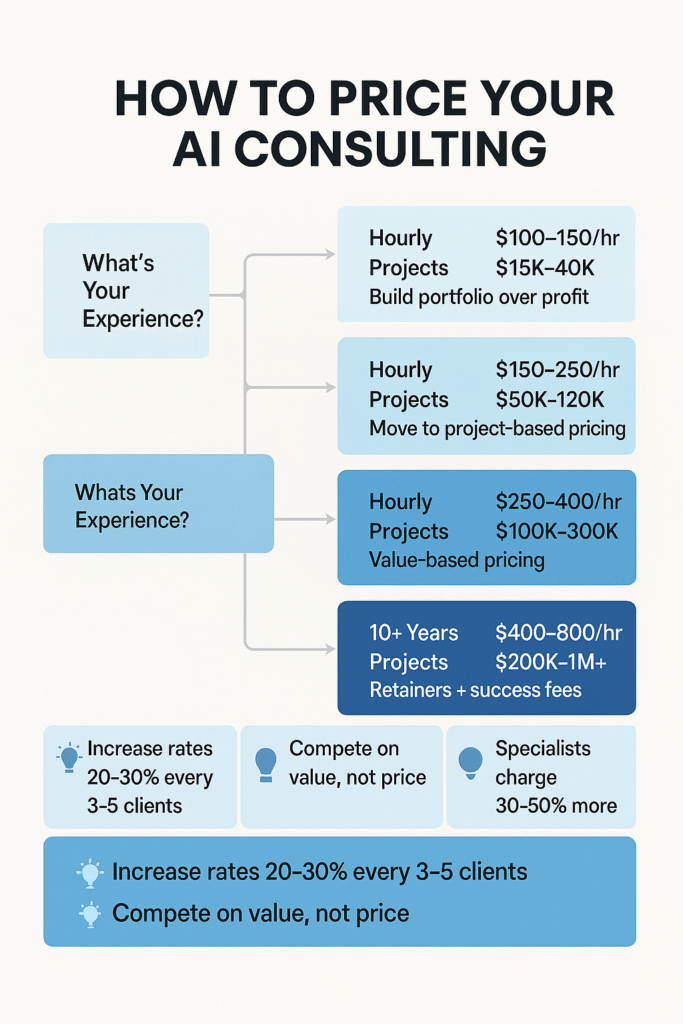
Starting out (first 3 clients):
- Charge enough to be taken seriously ($100-150/hour or $20-40K for small projects).
- Focus on building portfolio over maximizing income.
- Be honest: “I’m building my practice, so my rates are below market”.
Establishing (clients 4-20):
- Increase rates 20-30% every 3-5 clients.
- Move from hourly to project-based pricing.
- Start saying no to low-budget projects.
Established (ongoing practice):
- Charge based on value, not time
- Turn away clients who can’t afford you (refer them to someone less expensive)
- Focus on efficiency – work less, earn more
The Economics of Different Models
Solo independent consultant:
- Income ceiling: $300-500K/year (limited by your time).
- Overhead: 10-20% (tools, marketing, insurance).
- Flexibility: Maximum.
- Risk: Income stops if you stop working.
Small consulting firm (you + 2-5 employees):
- Income ceiling: $500K – $2M/year.
- Overhead: 40-60% (salaries, office, sales, admin).
- Flexibility: Medium.
- Risk: Managing people and steady deal flow.
Boutique firm (6-20 people):
- Income ceiling: $1M – $10M+/year
- Overhead: 50-70%
- Flexibility: Low (you’re running a business now)
- Risk: Scaling challenges, client concentration
Where the money really is:
- Recurring revenue (retained advisory): $10-50K/month per client.
- Speaking/training: $5-30K per engagement (very high margin).
- IP/Products: Tools, frameworks, or courses you sell alongside consulting.
- Success fees: Percentage of value created (risky but potentially lucrative).
The Hidden Costs Nobody Mentions
As an independent:
- Health insurance: $500-1,500/month
- Business insurance: $100-300/month
- Marketing/sales tools: $200-500/month
- Professional development: $5,000-15,000/year
- Accounting/legal: $3,000-10,000/year
- Taxes: 25-35% of income (self-employment tax is real)
- Unbillable time: 40-50% of your time goes to sales, admin, learning
Real math for independents: If you charge $200/hour and work 50 weeks:
- Theoretical max: $200 × 40 hours × 50 weeks = $400,000
- Actual billable: $200 × 20 hours × 40 weeks = $160,000 (accounting for utilization and vacation)
- After expenses (25%): $120,000
- After taxes (30%): $84,000
- This is equivalent to a ~$95,000 salaried position with benefits
You need to charge $250-300/hour to match a $150K salary once you factor in all costs.
Geographic Variations
Where rates are highest:
- San Francisco Bay Area: +30-50% premium
- New York City: +20-40% premium
- Seattle, Boston: +20-30% premium
- London, Singapore: +20-35% premium
Where rates are lower:
- Mid-size US cities: Market rate.
- Remote/distributed: 10-20% below market (but lower cost of living).
- International clients (hiring US consultants): Often willing to pay premium for expertise.
The remote consulting arbitrage: Live in a low cost-of-living area, charge rates based on client location. You can earn Bay Area rates while living in Austin, Boise, or Portugal.
Real Projects: What Works vs. What Clients Ask For
Let me share five composite projects based on real consulting engagements, showing the gap between initial requests and what actually delivered value.
Project 1: The “We Need AI” Healthcare System
What the client asked for: “We want to implement AI across our hospital system. Can you build us a predictive model for patient readmissions?”
What they actually needed: Their electronic health records system was a mess with inconsistent data entry, missing fields, and no data governance. They had no idea what their current readmission rate was or what factors drove it.
What we did:
- Month 1: Data audit and cleaning process design ($40K)
- Month 2-3: Built a simple logistic regression model as a baseline ($50K)
- Month 4-6: Implemented data governance and trained staff ($60K)
- Month 7-9: Developed more sophisticated model once data quality improved ($70K)
Results:
- Reduced 30-day readmissions by 18% (from 22% to 18%).
- More importantly: Improved data quality system-wide, enabling future AI projects.
- ROI: $2.4M annually from reduced readmissions alone.
Lesson: Most organizations aren’t ready for sophisticated AI. Start with data hygiene and simple models. Deliver quick wins while building the foundation for more complex solutions.
Project 2: The E-commerce “Recommendation Engine”
What the client asked for: “Build us a recommendation engine like Amazon’s. We want to increase sales by 30%.”
What they actually needed: Their site had basic UX problems (slow load times, confusing navigation, broken search). Adding recommendations wouldn’t help if customers couldn’t find products in the first place.
What we did:
- Week 1-2: Analyzed their data and customer behavior ($15K)
- Week 3-4: Fixed basic issues first (search, site speed) with their dev team ($20K)
- Week 5-8: Implemented a simple collaborative filtering recommendation system ($35K)
- Week 9-12: A/B tested and refined the algorithm ($25K)
Results:
- 12% increase in average order value (not 30%, but realistic)
- 8% increase in conversion rate
- The basic improvements drove 60% of the gains; AI drove the remaining 40%
- ROI: $180K annually on a $95K investment
Lesson: AI often isn’t the primary bottleneck. Fix obvious issues first. When you do implement AI, start simple and iterate based on real user behavior.
Project 3: The Manufacturing “Predictive Maintenance” Disaster
What the client asked for: “Implement predictive maintenance AI to reduce equipment downtime by 50%.”
What they actually needed: Their maintenance team didn’t trust technology and had decades of tribal knowledge. Any AI solution would fail without their buy-in.
What we tried (and initially failed):
- Month 1-2: Built a sophisticated model using sensor data ($60K)
- Month 3: Tried to deploy… maintenance team ignored it completely
- Month 4: Discovered the real problem in interviews with the floor team
What we actually did (second attempt):
- Month 5-6: Rebuilt system with maintenance team input ($40K)
- Designed it to augment their knowledge, not replace it
- Added feedback mechanism so they could flag when AI was wrong
- Month 7-9: Gradual rollout with hands-on training ($35K)
Results:
- 28% reduction in unplanned downtime (not 50%, but substantial)
- Maintenance team became AI champions and suggested new use cases
- ROI: $1.8M annually in reduced downtime and maintenance costs
Lesson: The best technical solution means nothing without user adoption. Involve end users early. Design systems that augment human expertise, not replace it.
Project 4: The Financial Services “Fraud Detection” Success
What the client asked for: “Our fraud detection has too many false positives. Customers are angry about blocked transactions.”
What they actually needed: Exactly what they asked for (rare!). They had good data, clear metrics, and realistic expectations.
What we did:
- Week 1-3: Analyzed current rule-based system and historical fraud data ($25K)
- Week 4-8: Developed ensemble model combining multiple ML approaches ($45K)
- Week 9-12: Extensive testing and calibration to optimize precision/recall tradeoff ($35K)
- Week 13-16: Staged rollout with real-time monitoring ($30K)
Results:
- Reduced false positives by 67% (from 3% to 1% of transactions)
- Maintained fraud detection rate (actually improved slightly from 89% to 91%)
- Customer complaints dropped by 75%
- ROI: $4.2M annually from reduced operational costs and improved customer satisfaction
Lesson: When clients have good data, clear success metrics, and realistic expectations, AI projects can deliver spectacular results. This is the exception, not the rule.
Project 5: The Startup “Customer Churn Prediction” Pivot
What the client asked for: “Build a model to predict which customers will churn so we can save them.”
What they actually needed: First, to understand why customers were churning. Then, a scalable intervention strategy.
What we did:
- Week 1-2: Analyzed churn patterns and conducted customer interviews ($12K)
- Week 3-4: Discovered 80% of churn was due to one confusing onboarding step ($8K)
- Week 5-6: Helped them fix the onboarding UX issue ($10K saved them massive churn)
- Week 7-10: Built simple churn prediction for the remaining 20% ($20K)
- Week 11-12: Designed automated intervention campaigns ($15K)
Results:
- Reduced overall churn by 42% (from 8.5% to 4.9% monthly)
- Most impact came from the UX fix, not the AI
- AI-driven interventions saved additional 0.6% of churning customers
- ROI: $960K annually in retained revenue
Lesson: Sometimes the best AI consulting involves telling clients they don’t need AI for their biggest problem. Solve the root cause first. Use AI for what remains.
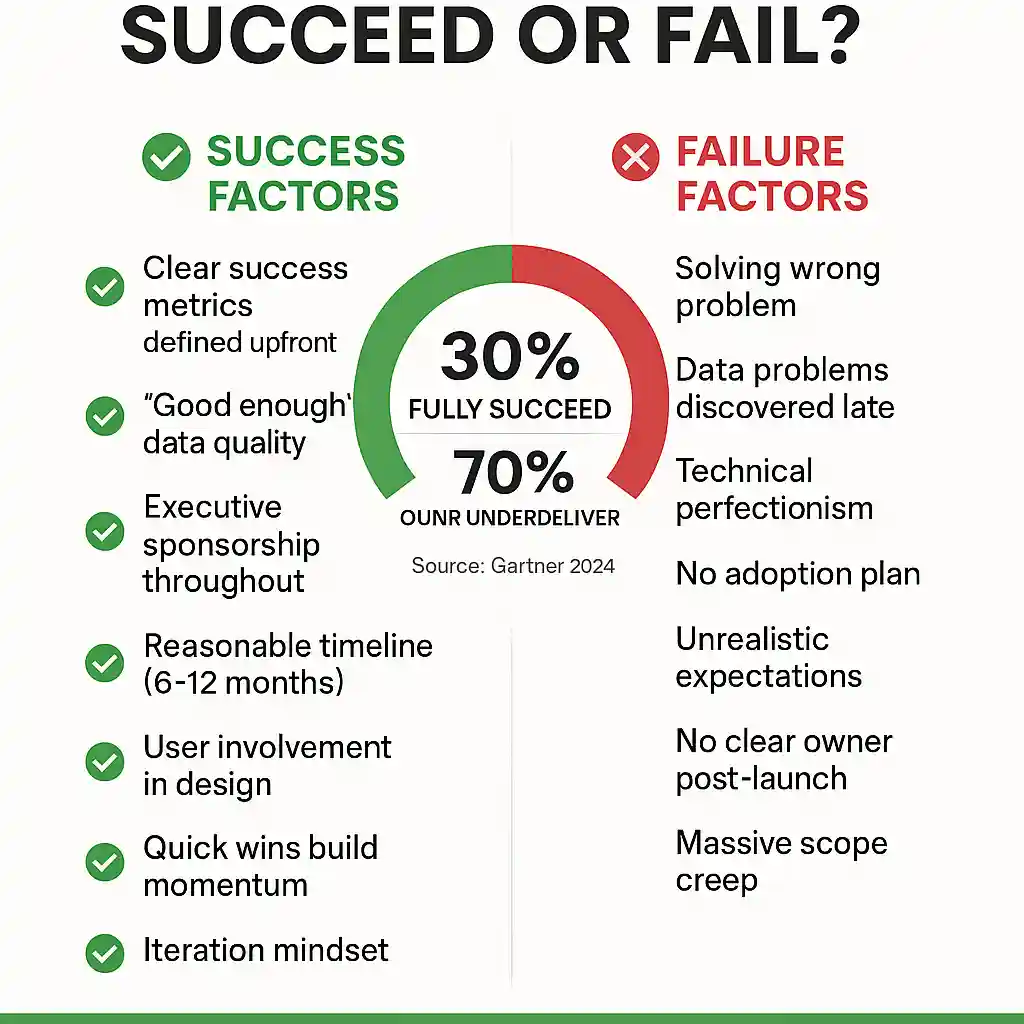
Common Patterns in Successful Projects
What makes AI projects succeed:
- Clear, measurable success metrics defined upfront
- Good enough data (doesn’t need to be perfect, but needs to exist)
- Executive sponsorship that persists through challenges
- Reasonable timeline expectations (6-12 months for substantial results)
- User involvement throughout design and implementation
- Quick wins that build momentum and trust
- Iteration mindset rather than “we’ll get it perfect the first time”
What makes AI projects fail:
- Solving the wrong problem (often symptoms rather than root causes)
- Data problems discovered too late (dirty, insufficient, or inaccessible data)
- Technical perfectionism that delays delivering any value
- Lack of change management (building it doesn’t mean they’ll use it)
- Unrealistic expectations from seeing demos or reading hype
- No clear owner after the consultant leaves
- Scope creep turning a focused project into a boil-the-ocean initiative
The Types of Projects You’ll Encounter
Tier 1: Discovery/Strategy (20% of projects)
- AI readiness assessments
- Opportunity identification workshops
- AI strategy and roadmap development
- Vendor selection assistance
- Duration: 2-8 weeks
- Value: Prevents expensive mistakes
Tier 2: Proof of Concept (30% of projects)
- Validating if AI can solve the problem
- Small-scale implementations
- Model prototyping and testing
- Duration: 1-3 months
- Value: De-risks larger investments
Tier 3: Implementation (40% of projects)
- Building and deploying production models
- Integration with existing systems
- Training and change management
- Duration: 3-9 months
- Value: Delivers actual business outcomes
Tier 4: Optimization/Support (10% of projects)
- Improving existing models
- Troubleshooting underperforming AI
- Scaling successful pilots
- Duration: Ongoing or 1-6 months
- Value: Ensures sustained performance
Most consultants do a mix. Strategy projects have high margins but are harder to scale. Implementation projects are more substantial but require more resources.
Common Failures and How to Avoid Them
Let me share the mistakes that kill AI projects – and careers. I’ve made several of these myself.
Failure Pattern #1: Solving the Wrong Problem
What it looks like: Client: “We need AI to predict which leads will convert.” You: Build a sophisticated lead scoring model. Result: Model is accurate but sales team ignores it because their real problem is they don’t have enough leads in the first place.
Why it happens:
- Not asking “why?” enough times
- Accepting the client’s framing without challenging it
- Building solutions before understanding the problem
- Skipping stakeholder interviews to save time
How to avoid it:
- Spend 20-30% of project time in discovery
- Interview people who will use the system, not just who commissioned it
- Ask: “If this works perfectly, what changes in your day-to-day work?”
- Validate that solving this problem actually moves key business metrics
Red flags:
- Client can’t articulate current state metrics
- Different stakeholders describe different problems
- Nobody can explain what they’ll do differently with AI insights
Failure Pattern #2: The Data Dumpster Fire
What it looks like:
- “We have tons of data!” (it’s 70% duplicate, missing critical fields, or inconsistent)
- “Our data is in Salesforce!” (and also in three Excel spreadsheets with different schemas)
- “Data access won’t be an issue!” (requires 6 weeks of legal approvals you discover in month 2)
Why it happens:
- Trusting client assertions about data quality
- Not auditing data in the first week
- Underestimating data cleaning effort (always 3x what you think)
- Starting model development before understanding the data
How to avoid it:
- Always include a data audit in week 1
- Add 50% buffer to timeline for data issues (you’ll use it)
- Make data quality a client deliverable, not your responsibility
- Build data cleaning into the project scope and budget
- Have a “go/no-go” decision point after data audit
Red flags:
- Client can’t provide sample data immediately
- “The data is fine, we use it for reports!” (reports and ML have different requirements)
- Data is scattered across multiple systems with no single source of truth
Failure Pattern #3: The Perfectionism Trap
What it looks like: Spending 6 months building a model with 95% accuracy when a model with 80% accuracy would have delivered value in month 2.
Why it happens:
- Data scientists’ and engineers’ instinct to optimize
- Not understanding the business value curve (first 80% of accuracy delivers 95% of value)
- Comparing to academic standards rather than business alternatives
- Fear of delivering something “not good enough”
How to avoid it:
- Set “minimum viable accuracy” based on business needs
- Ship something in the first 30-45 days (even if it’s simple)
- Remember: A good model deployed beats a perfect model in development
- Ask: “Is this 5% accuracy improvement worth delaying launch 2 months?”
Red flags:
- No intermediate deliverables in first 60 days
- Constant requests for “just a bit more time to improve the model”
- Can’t articulate what business decision changes with higher accuracy
Failure Pattern #4: The “Built It But Nobody Uses It” Catastrophe
What it looks like: You deliver a technically excellent AI system. Six months later, you check in and discover it’s not being used – or usage dropped off after the first month.
Why it happens:
- Not involving end users in design
- Making AI a black box that users don’t trust
- Not providing training beyond initial launch
- Not integrating into existing workflows
- No clear owner responsible for adoption after you leave
How to avoid it:
- Involve end users from week 1 (shadowing, interviews, co-design sessions)
- Build feedback mechanisms so users can flag bad predictions
- Make AI explainable (“the model suggested this because…”)
- Create champions among the user base
- Training should be ongoing, not one-time
- Ensure someone owns the system after you’re gone
Red flags:
- You never meet the people who will actually use the system
- Client says “don’t worry about change management”
- No budget allocated for training and adoption
- System requires users to change their entire workflow
Failure Pattern #5: Scope Creep Death Spiral
What it looks like:
- Week 1: Build a customer churn model
- Week 4: “Can we also predict lifetime value?”
- Week 8: “Actually, we need this for all three customer segments”
- Week 12: “Let’s add these 20 other features”
- Month 6: Project is over budget, behind schedule, and no one’s happy
Why it happens:
- Vague initial scope
- Saying yes to “small additions” without adjusting timeline/budget
- Client doesn’t understand cumulative impact of changes
- Fear of seeming inflexible
How to avoid it:
- Define scope explicitly with clear boundaries
- Create a change request process for additions
- Track scope changes and their impact publicly
- Learn to say: “That’s a great idea – let’s add it to phase 2”
- Put boundaries in the contract (“Includes modeling for one customer segment. Additional segments billed separately.”)
Red flags:
- Client says “let’s keep it flexible” about scope
- No written statement of work
- Meetings frequently introduce “small additions”
Failure Pattern #6: The Technical Debt Timebomb
What it looks like: Your model works great in production for 3 months, then starts failing. Nobody knows how to fix it because there’s no documentation, monitoring, or handoff to a maintenance team.
Why it happens:
- Rushing to deployment without building operational infrastructure
- Assuming someone else will handle monitoring and maintenance
- Not documenting code because “it’s obvious”
- Not training a handoff team before you leave
How to avoid it:
- Build monitoring and alerting from day 1 of deployment
- Document as you go (code comments, architecture docs, runbooks)
- Create a transition plan 30 days before project ends
- Train the team that will maintain the system
- Set up a retainer for post-project support
Red flags:
- No one designated to own the system after launch
- Client expects AI to “just work” forever with no maintenance
- No budget for monitoring infrastructure
- Deployment plan doesn’t include failure scenarios
Failure Pattern #7: The Ethical Landmine
What it looks like: Your model works well but has bias you didn’t catch. Six months after launch, there’s a lawsuit, media coverage, and your name is attached to it.
Why it happens:
- Treating fairness as a checkbox instead of ongoing work
- Not testing model behavior across demographic groups
- Using historical data that encodes past discrimination
- Skipping explainability because it’s technically harder
How to avoid it:
- Test for bias explicitly across protected groups
- Do adversarial testing: “How could this model be gamed or cause harm?”
- Document your bias testing and mitigation efforts
- Include fairness metrics alongside accuracy metrics
- When in doubt, bring in an external ethics reviewer
- Have a “would I be comfortable explaining this model on national TV?” test
Red flags:
- Client dismisses ethical concerns as “overthinking”
- No diverse team reviewing the model
- Historical data known to have bias but “that’s all we have”
- Model makes high-stakes decisions (hiring, lending, healthcare) without explainability
Failure Pattern #8: The Communication Breakdown
What it looks like: You think the project is going great. The client is increasingly frustrated but doesn’t tell you until the final presentation when they say “this isn’t what we wanted at all.”
Why it happens:
- Not establishing regular check-ins
- Showing work too late (waiting for perfection)
- Using technical language that obscures misalignment
- Not explicitly confirming understanding: “Here’s what I heard you need. Is that right?”
How to avoid it:
- Weekly check-ins minimum, even if brief
- Show work early and often (even rough drafts)
- Create decision points where client explicitly approves direction
- Use their language in summaries: “You need to reduce costs by X, and here’s how we’re tracking toward that”
- Overcommunicate when things go wrong (they’ll go wrong)
Red flags:
- Client seems disengaged in meetings
- You’re not sure who the actual decision-maker is
- Long stretches (2+ weeks) without client communication
- Client’s feedback is vague (“looks good, keep going”)
How to Recover from Failures
Because failures will happen. Here’s how to handle them:
If you catch a problem early:
- Tell the client immediately (don’t hope it will get better)
- Come with solutions, not just problems
- Adjust scope, timeline, or budget accordingly
- Document what went wrong and how you’re addressing it
If a project is clearly failing:
- Acknowledge it explicitly with the client
- Pivot to salvaging whatever value you can
- Offer options: reduced scope, phase 2 approach, pause and reassess
- Even a “failed” project can end with the client respecting you if you handle it professionally
After the project:
- Conduct a post-mortem (internal and with client if possible)
- What would you do differently?
- Update your process to prevent this failure mode
- Be honest in future sales calls: “I’ve seen this fail when X happens, so we’ll do Y instead”
The consultants who survive aren’t those who never fail. They’re the ones who fail forward, learn, and don’t repeat the same mistakes.
Industry Demand and Career Outlook for AI Consultants
Let me give you the realistic picture, not the hype.
The Demand Reality in Late 2025
What’s true:
- AI adoption is accelerating across industries
- Most organizations lack in-house AI expertise
- Companies are shifting from “should we use AI?” to “how do we use AI effectively?”
- The gap between AI hype and AI capability is creating demand for realistic advisors
What’s also true:
- The market is getting crowded with “AI consultants” who took a weekend bootcamp
- Large consulting firms are aggressively expanding their AI practices
- Some enterprise AI platforms are building in-house AI teams, reducing external consulting needs
- Easy wins have been picked; remaining problems are harder and more complex
Net result: High demand for good AI consultants, but increasing competition from mediocre ones. Differentiation matters more than ever.
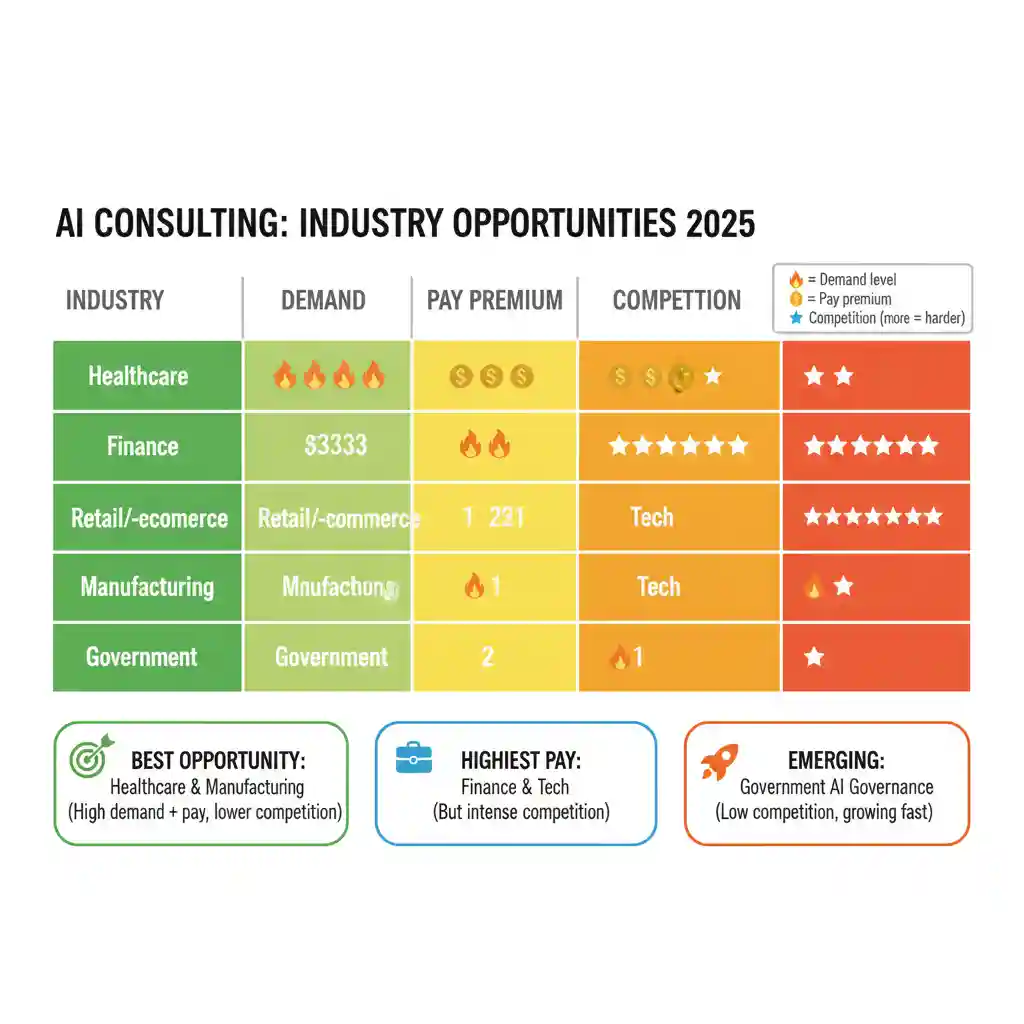
Where the Opportunities Are
Industries with highest demand:
1. Healthcare (Hot)
- Predictive diagnostics
- Operational efficiency (staffing, bed management)
- Clinical decision support
- Drug discovery support
- Regulatory complexity creates consulting opportunities
Why it’s attractive: High budgets, clear ROI, undersupplied market Challenges: Heavy regulation, slow decision cycles, data sensitivity
2. Financial Services (Very Hot)
- Fraud detection and prevention
- Risk assessment and credit scoring
- Algorithmic trading support
- Regulatory compliance (AI governance)
- Customer service automation
Why it’s attractive: Large budgets, sophisticated clients, recurring projects Challenges: Risk-averse culture, strict regulatory environment
3. Retail/E-commerce (Saturated but Still Growing)
- Personalization and recommendations
- Demand forecasting and inventory optimization
- Dynamic pricing
- Customer service automation
- Supply chain optimization
Why it’s attractive: Clear metrics (revenue impact), fast iteration cycles Challenges: Lower margins than finance/healthcare, lots of competition
4. Manufacturing (Underserved)
- Predictive maintenance
- Quality control automation
- Supply chain optimization
- Process optimization
- Computer vision for inspection
Why it’s attractive: Tangible ROI, less competition than other sectors Challenges: Requires domain expertise, slower to adopt new tech
5. Professional Services (Emerging)
- Document analysis and automation
- Legal research and discovery
- Accounting automation
- Consulting augmentation (meta!)
Why it’s attractive: High-value clients, relationship-driven sales Challenges: Concerns about job replacement, ethical considerations.
The Specialization Imperative
In 2020: “I’m an AI consultant” was enough In 2023: “I specialize in NLP” started mattering In 2025: You need something like “I help healthcare providers implement HIPAA-compliant AI for patient care workflows”
Why specialization wins:
- Command 30-50% higher rates
- Easier to find clients (they search for specialists)
- Build reusable frameworks and IP
- Become known in a community
- Reduce sales cycle (less “prove you understand our industry”)
Warning: Don’t specialize too early. Do 5-10 diverse projects first to find what you’re good at and enjoy.
Market Sizing and Growth Projections
Global AI consulting market:
- 2024: ~$50 billion
- 2025: ~$70 billion (estimated)
- 2030: Projected $300+ billion
But context matters:
- This includes everything from strategy consulting to implementation to training
- Large enterprises account for 70% of spending
- SMB market is growing faster but smaller absolute dollars
- Geographic concentration in US, UK, China, EU
For individual consultants:
- Room for thousands more specialized AI consultants
- But tens of thousands are entering the market
- Quality differentiation will determine success
The AI Consulting Lifecycle Stage
We’re transitioning from early adopters to early majority:
2015-2020: The Hype Phase
- “AI will solve everything!”
- Companies experimenting with pilots
- High failure rate (80%+)
- Consultants could be generalists
2020-2023: The Reality Check
- “AI is harder than we thought”
- Companies focusing on specific use cases
- Success rate improving (60% see some value)
- Specialization emerging
2023-2025: The Integration Phase (We are here)
- “How do we make AI actually work at scale?”
- Companies building AI into operations
- Success rate depends on execution (still ~30% fully successful)
- Deep expertise and change management critical
2025-2030: The Maturity Phase (Coming)
- AI becomes table stakes, not differentiator
- Consulting shifts to optimization and governance
- Commoditization of simple AI projects
- Premium for sophisticated integration and ethics
What this means for you:
- Next 5 years: Great opportunity for skilled consultants
- After that: Market will mature, margins may compress
- Build expertise and reputation now while returns are high
Competition Landscape
You’re competing with:
Other independent consultants:
- Advantage: More flexible, often less expensive
- Disadvantage: Less brand recognition, smaller teams
Large consulting firms (Accenture, Deloitte, McKinsey, etc.):
- Advantage: Brand, resources, established relationships
- Disadvantage: Expensive, bureaucratic, junior staff on projects
Boutique AI consulting firms:
- Advantage: Specialized expertise, nimble
- Disadvantage: Limited to firm’s specific domain
Offshore consulting:
- Advantage: Lower cost
- Disadvantage: Time zones, communication challenges, variable quality
In-house teams:
- Not direct competition, but reduces addressable market
- Opportunity: Help companies build in-house teams
AI startups/vendors:
- Compete by selling packaged solutions
- Opportunity: Partner to implement their tech
Your competitive advantage:
- Specialized expertise in a niche
- Personal relationships and trust
- Flexibility and responsiveness
- Results track record
- Domain-specific knowledge large firms don’t have
Future-Proofing Your Career
What will change:
- AutoML and no-code tools will handle simple cases
- Generative AI will automate some coding and analysis
- More companies will build internal capabilities
- Regulation will increase (creating new opportunities)
What won’t change:
- Need for strategic thinking about where to apply AI
- Need for someone to bridge technical and business worlds
- Need for change management and adoption support
- Need for ethical oversight and bias auditing
- Need for integration with messy real-world systems
How to stay relevant:
- Move up the value chain: From implementation to strategy
- Develop proprietary methods: Frameworks, tools, IP
- Build thought leadership: Writing, speaking, teaching
- Create recurring revenue: Retainers, training, ongoing optimization
- Consider building products: SaaS tools, courses, templates
- Expand to adjacent services: Data strategy, ML ops, AI governance
Skills to develop for the future:
- AI ethics and governance (regulation is coming)
- Generative AI applications (LLMs, image generation)
- AI operations and maintenance (keeping AI systems healthy)
- Cross-functional AI integration (connecting systems)
- AI strategy for executives (non-technical advisory)
The Honest Career Projection
Optimistic scenario:
- Strong demand continues through 2030
- Successful consultants earn $200K-$500K+ annually
- Build valuable expertise that compounds
- Option to scale into a firm or sell IP/products
Realistic scenario:
- Solid demand with increasing competition
- Mid-career earnings $150K-$300K
- Need to continuously adapt and specialize
- Some years feast, some years famine
Pessimistic scenario:
- Market commoditizes faster than expected
- Margins compress as tools become easier
- Large firms capture enterprise market
- Indies compete mainly on price
My assessment: Realistic scenario most likely. This is a good career for the next 5-10 years, but you need to build expertise and adapt continuously. It’s not a “learn it once and coast” career.
Your Next Steps: The Action Plan
Enough theory. Here’s what to actually do, depending on where you are right now.
If You’re Just Starting (No AI Experience Yet)
Month 1-2: Build Foundation
- Complete Andrew Ng’s Machine Learning course on Coursera
- Learn Python basics (focus on pandas, numpy, matplotlib)
- Study one successful AI case study per week deeply (not just surface-level)
- Join AI communities: r/MachineLearning, local AI meetups, LinkedIn groups
Month 3-4: Get Hands-On
- Complete 3 Kaggle tutorials in different domains (NLP, computer vision, tabular data)
- Build a simple project with public data in an industry you find interesting
- Write a detailed article about your project and learnings (post on Medium, LinkedIn)
- Set up a simple portfolio website (GitHub Pages is free)
Month 5-6: Develop Business Context
- Take a business fundamentals course (Coursera has free options)
- Read “The Lean Startup” and “Crossing the Chasm” for business thinking
- Interview 3-5 people in roles you’re interested in (informational interviews)
- Practice explaining technical concepts to non-technical friends/family
Month 7-12: Get Experience
- Apply for junior data scientist or ML engineer roles (even if you transition later)
- Or: Get involved in AI projects at your current company
- Or: Do free/cheap work for nonprofits to build portfolio (max 2 projects)
- Continue learning: Pick one specialized area (NLP, computer vision, etc.) to go deeper
- Start building your network: Attend at least one conference or meetup monthly
Goal: By month 12, have 2-3 projects you can show and discuss, understand AI fundamentals, and have some business context.
If You’re a Technical Person (Data Scientist, ML Engineer, Software Developer)
Immediate (Week 1-4):
- Audit your current projects for “consulting moments” (times you advised on strategy, not just implementation)
- Create case studies for your best projects (problem, approach, results, business impact)
- Identify your niche: What industry or problem type are you most experienced in?
- Set up professional online presence: LinkedIn, portfolio site, maybe Medium
Short-term (Month 2-4):
- Start volunteering to help other teams at work (build consulting muscle internally)
- Practice translating technical work into business language (every project, write an “executive summary”)
- Take on a small side project as a “consultant” (friend’s business, nonprofit)
- Read: “The Trusted Advisor” and “Flawless Consulting”
- Start creating content: Write about your technical work in business terms
Medium-term (Month 5-12):
- Take on bigger consulting projects (while still employed)
- Build your network in your target industry
- Price your first few projects at $100-150/hour to get experience
- Save 6-12 months of expenses if planning to go independent
- Create a business plan: Who’s your ideal client? What problem do you solve? What’s your positioning?
Transition point:
- Don’t quit your job until you have 2-3 paid clients lined up
- Or: Join a consulting firm first to learn the business side
If You’re a Business/Consulting Person (Consultant, Analyst, Product Manager)
Immediate (Week 1-4):
- Start learning AI fundamentals (Andrew Ng’s course or fast.ai)
- Read “Prediction Machines” and “AI Superpowers” for business context
- Identify which of your past projects could have benefited from AI
- Find a technical partner who can handle implementation (initially)
Short-term (Month 2-4):
- Complete a hands-on project (Kaggle competition or personal project) to understand the development process
- Take on a “strategy only” AI consulting project where someone else does implementation
- Build enough technical literacy to ask good questions and spot BS
- Learn one AI domain deeply enough to consult on it (maybe NLP or computer vision)
Medium-term (Month 5-12):
- Position yourself as “AI strategy consultant” – emphasize business value and change management
- Continue learning technical skills (you don’t need to be an expert, but need to be credible)
- Build a network of technical partners for implementation
- Create frameworks and methodologies for AI strategy and readiness
Your positioning:
- “I help [industry] companies identify and prioritize AI opportunities that actually deliver ROI”
- Emphasize business acumen and change management, partner for deep technical work
If You’re a Domain Expert (Industry Specialist)
Immediate (Week 1-4):
- Learn AI fundamentals with focus on applications in your industry
- Document the top 10 problems in your industry where AI could help
- Research what AI solutions already exist in your space
- Connect with AI practitioners in your industry (LinkedIn, conferences)
Short-term (Month 2-4):
- Partner with a technical AI person on a project in your domain
- Write about AI opportunities in your industry (you have unique insight)
- Build enough technical understanding to evaluate solutions and vendors
- Position yourself as the bridge: domain expertise + AI awareness
Medium-term (Month 5-12):
- Develop a specialty: “AI for [specific problem] in [your industry]”
- Build a network of implementation partners
- Create an AI readiness assessment specific to your industry
- Focus on strategy and oversight, partner for implementation
Your positioning:
- “I’ve spent [X years] in [industry] and now help companies identify where AI can solve real problems versus hype”
- Your domain expertise is the differentiator, AI is the tool.
Resources Worth Your Time
Courses (Prioritize these):
- Andrew Ng’s Machine Learning Specialization (Coursera) – Start here
- Fast.ai Practical Deep Learning – More hands-on
- Google’s Machine Learning Crash Course – Quick fundamentals
- MIT’s Business Analytics courses – Bridge to business
Books:
- “The Hundred-Page Machine Learning Book” – Technical primer
- “Prediction Machines” – AI economics and strategy
- “The Trusted Advisor” – Consulting fundamentals
- “Data Science for Business” – Bridges both worlds
- “Weapons of Math Destruction” – AI ethics
Communities:
- Local AI/ML meetups (in-person networking beats online)
- Reddit: r/MachineLearning, r/datascience, r/consulting
- LinkedIn: Join AI groups in your target industry
- Conferences: NeurIPS, ICML (technical), or industry-specific AI events
Tools to learn:
- Python (pandas, scikit-learn, matplotlib)
- Jupyter notebooks
- SQL
- Basic cloud platforms (AWS/GCP/Azure fundamentals)
- Visualization tools (Tableau or Power BI)
Don’t waste time on:
- Certifications beyond the first 1-2 (portfolio matters more)
- Learning every AI framework (pick one, learn it well)
- Theory without practice (build things!)
- Generic business books (you need AI-specific and industry-specific knowledge)
The 90-Day Sprint to First Client
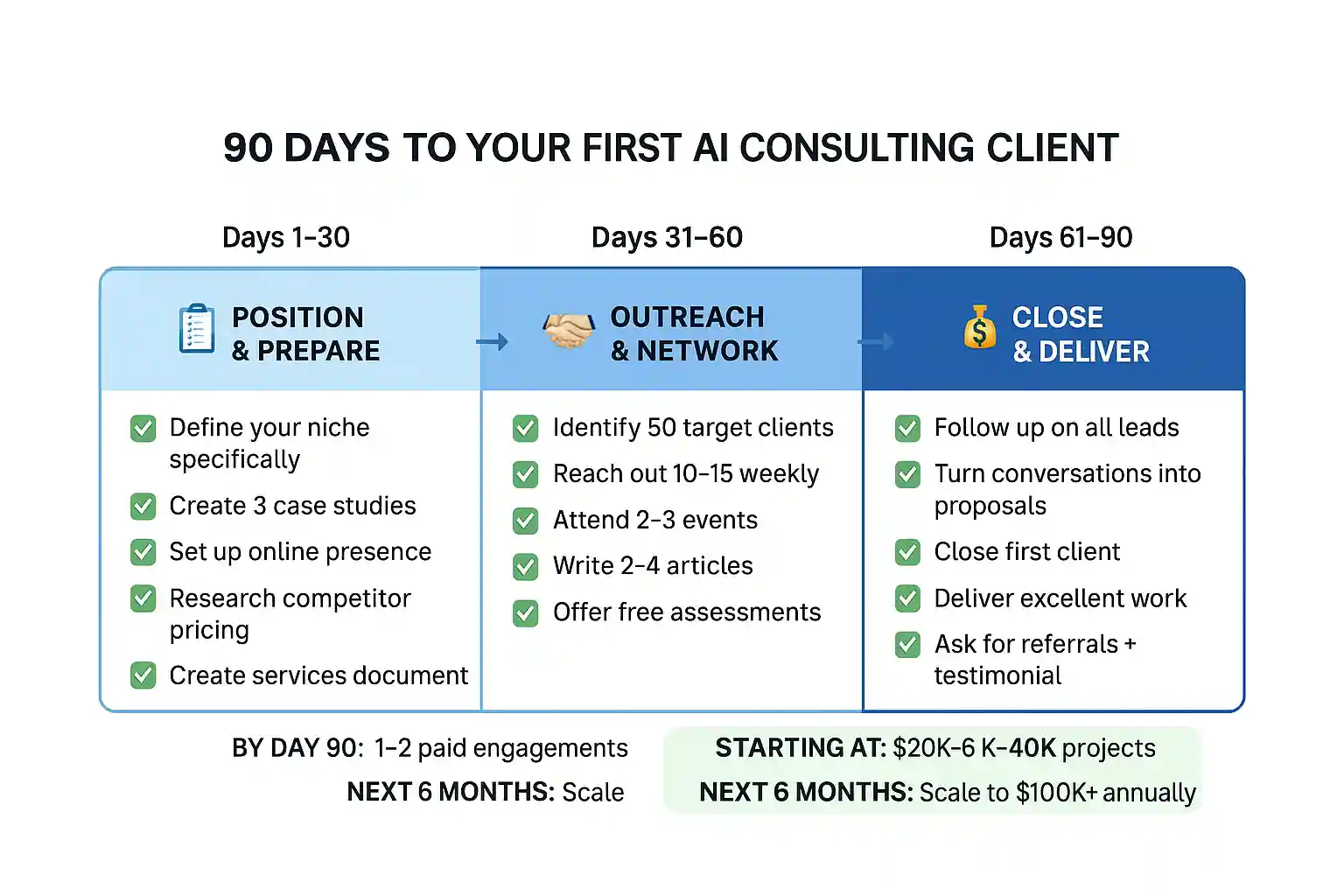
If you already have some AI background and want to land your first consulting client fast:
Days 1-30: Position and Prepare
- Define your niche specifically (who you help, what problem you solve)
- Create 3 detailed case studies (even if from employment, presented as consulting insights)
- Set up professional online presence
- Price research: What do competitors charge?
- Create a simple one-page “services” document
Days 31-60: Outreach and Network
- Identify 50 target potential clients (companies in your niche with AI needs)
- Reach out to 10-15 per week (personalized messages, not spam)
- Attend 2-3 industry events and actually talk to people
- Write 2-4 articles showcasing your expertise
- Offer free “AI readiness assessment” to promising leads (1-2 hours, builds trust)
Days 61-90: Close and Deliver
- Follow up with everyone from outreach
- Turn conversations into proposals (start with small scope)
- Close first client (even at reduced rate for testimonial)
- Deliver excellent work and ask for referrals
- Document everything for your next case study
Realistic expectation: If you execute well, you should have 1-2 paid engagements by day 90. Not full-time income yet, but validation.
The Long Game: Year 1-5
Year 1: Survival and Learning
- Get 5-10 clients (any you can find)
- Make mistakes and learn from them
- Discover what you’re actually good at
- Goal: Break even, build portfolio, find your niche
Year 2: Specialization
- Focus on your niche
- Increase rates by 30-50%
- Turn away work that doesn’t fit
- Goal: Sustainable income, clear positioning
Year 3: Authority Building
- You’re known for something specific
- Clients come to you (less outbound sales)
- Speaking, writing, teaching
- Goal: Premium rates, selective clients
Year 4-5: Scale or Specialize Further
- Option A: Build a small firm (hire people)
- Option B: Stay boutique, work less, earn more
- Option C: Create products/IP alongside consulting
- Goal: Financial security, strategic choices
When to Quit Your Day Job
Don’t quit when:
- You just got your first client
- You’re excited but don’t have 6+ months expenses saved
- You don’t have a clear plan for finding clients 2-6
- Your partner/family isn’t on board
Do quit when:
- You have 3+ months of work lined up
- You have 6-12 months expenses saved
- You have a pipeline of potential clients
- You’ve proven you can actually deliver results
- The opportunity cost of staying is higher than the risk of leaving
Or don’t quit at all:
- Many successful consultants do it part-time for years
- Lower risk, slower growth
- Keep benefits and stability
- Eventually your consulting income might exceed salary
The Most Important Next Step
Stop reading and do one thing today:
Pick ONE based on where you are:
- Complete beginner: Enroll in Andrew Ng’s course (or Fast.ai) and do lesson 1 today
- Technical background: Create one case study from your past work in business language
- Business background: Build a simple model (any tutorial) to understand the process
- Have some experience: Reach out to 5 people in your target industry this week
- Ready to consult: Write a one-page “here’s what I do and who I help” document
The difference between people who become consultants and people who think about becoming consultants is action. Small, consistent actions compound.
Final Thoughts: Is This Career Right for You?
Let me be honest about who thrives as an AI consultant and who struggles.
You’ll Probably Love This If You:
- Enjoy variety (every project is different)
- Like solving puzzles with unclear solutions
- Can handle ambiguity and changing requirements
- Enjoy both technical and people aspects
- Want to see direct business impact
- Are comfortable with self-directed learning
- Don’t mind sales and business development
- Prefer depth over breadth in specialization
You’ll Probably Struggle If You:
- Need structure and clear direction
- Prefer deep technical work over mixed responsibilities
- Dislike uncertainty or risk
- Hate sales and self-promotion
- Want stable, predictable income
- Prefer working alone to managing stakeholders
- Get frustrated explaining technical concepts to non-technical people
- Don’t want to handle administrative work
The Realistic Upside
- Intellectually stimulating work
- High income potential ($150K-$500K+)
- Flexibility and autonomy
- Direct impact on business outcomes
- Continuous learning and growth
- Option to scale or stay boutique
The Realistic Downside
- Income variability (feast and famine)
- Constant need to find new clients
- Dealing with challenging clients and politics
- Working with messy, real-world data and systems
- Projects that fail despite your best efforts
- Isolation if independent
- Keeping up with rapidly changing tech
The Verdict
AI consulting is one of the most interesting and lucrative careers in tech right now – if you have the right mix of skills and temperament. The next 5-10 years will be golden for specialists who can deliver real results, not just hype.
But it’s not a career for people seeking stability or those who want to focus purely on technical OR purely on business. You have to enjoy the messy middle ground where technology meets organizational reality.
The consultants who succeed:
- Continuously learn and adapt
- Deliver real value, not just fancy demos
- Manage expectations honestly
- Build genuine expertise in a niche
- Treat clients as partners, not transactions
If that sounds like you, stop overthinking and start doing. The market is here, the demand is real, and there’s room for consultants who combine technical competence with business sense and honest communication.
The AI revolution isn’t coming – it’s here. Companies need guides who can navigate it realistically. That could be you.
Frequently Asked Questions
Data scientists build models and analyze data. AI consultants define strategy, identify opportunities, manage projects, ensure adoption, and often oversee data scientists. A data scientist answers “how do we build this?” An AI consultant answers “what should we build and why?”
No. While it helps with credibility early in your career, most successful consultants have Master’s degrees or less. What matters more: practical experience delivering results, business acumen, and communication skills. PhDs often struggle with the business and consulting aspects.
If you’re starting from scratch: 2-3 years to build credible experience. If you have technical background: 6-12 months to transition. If you have consulting background: 1-2 years to build AI expertise. You can start doing small projects earlier while building skills.
$100-150/hour or $15,000-40,000 for small projects (4-8 weeks). Increase 20-30% every 3-5 clients. Don’t charge less than $100/hour or you won’t be taken seriously. Frame early projects as “building my practice so my rates are below market.”
Yes, and many people do. Clear it with your employer to avoid conflicts. This is the lowest-risk path. Moonlight on weekends for 6-12 months while building client base and savings before going full-time.
They help early for credibility but matter less than portfolio. Consider 1-2: Google’s Machine Learning Engineer, AWS Machine Learning Specialty, or Certified AI Consultant (CAIC). After your first few successful projects, nobody cares about certificates.
Don’t specialize too early. Do 5-10 diverse projects first. If you pick wrong, pivot – takes 3-6 months to reposition. It’s better to specialize in something imperfect than stay a generalist forever.
Tell the client immediately. Come with solutions. Options: reduce scope, pivot approach, pause and reassess, or end the engagement professionally. Even failed projects can end with client respecting you if you’re honest and handle it well.
About 30% are considered fully successful by clients. Another 40% deliver partial value. 30% fail or get abandoned. Your job is to be in the first category by managing expectations, starting small, and focusing on business value over technical impressiveness.
Firm first if: you want to learn the business, prefer stability, or lack confidence. Independent if: you have clients lined up, want maximum flexibility, and are comfortable with risk. Many people do firm → independent after 2-3 years.
Finance and healthcare pay premium rates (20-40% above average). Tech and e-commerce pay well but are more competitive. Manufacturing and retail pay less but have less competition. Government pays least but most stable.
Simple tasks (basic models, standard analysis) are being automated. Strategic thinking, stakeholder management, change management, and complex integration aren’t. Move up the value chain to strategy and oversight to stay relevant.
They’ll still need consultants for: specialized expertise, objective outside perspectives, temporary capacity, and complex integrations. Like other consulting fields, the need evolves but doesn’t disappear.
Good signs: Clear success metrics, executive sponsorship, good enough data, reasonable timeline, willingness to start small. Bad signs: Vague goals, no data audit, unrealistic expectations, no budget for adoption, “we need this in 6 weeks.”
Ready to start? Pick one action from the Next Steps section and do it today. The best time to start was 5 years ago. The second-best time is now.