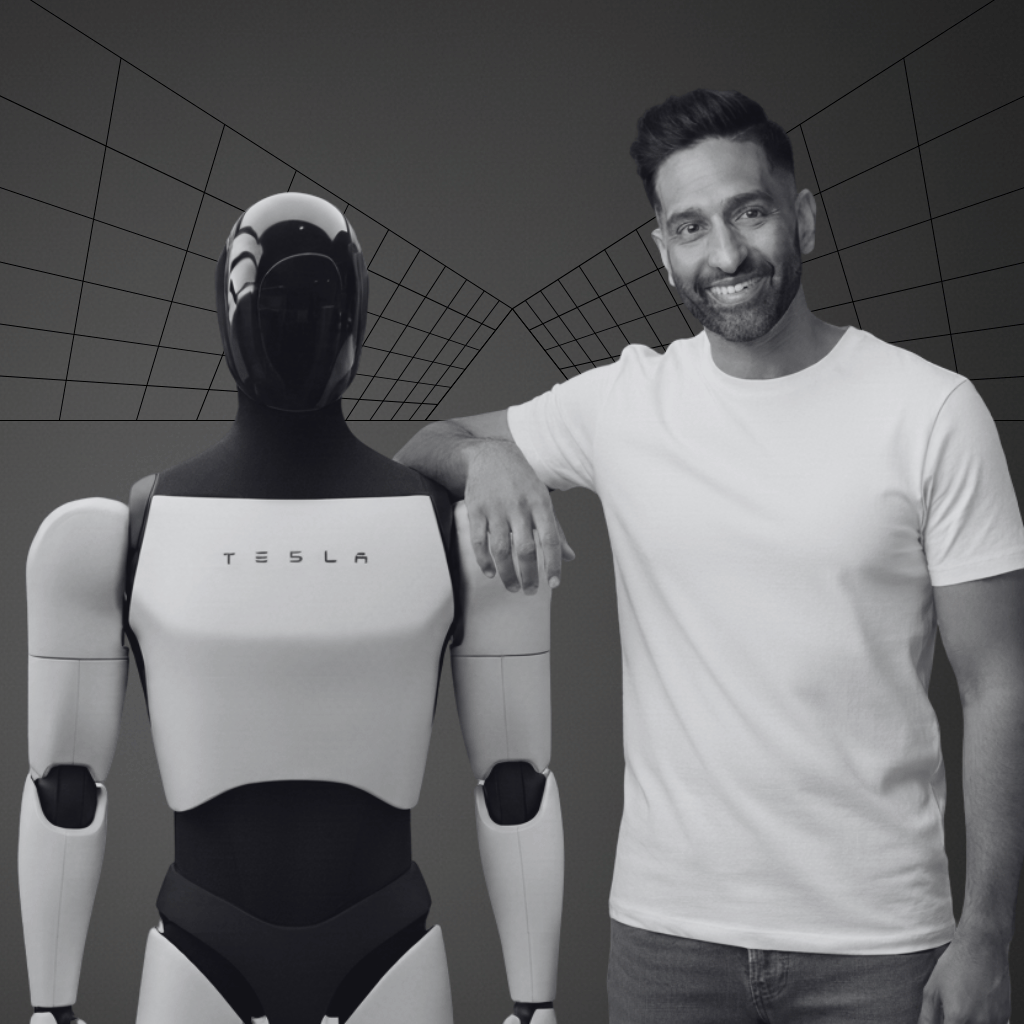
There’s a chart Tesla released recently – Figure 3 in their Optimus development update – that should have stopped every tech executive in their tracks.
It didn’t, of course. Most people probably scrolled past it while checking their phone at a red light.
But that chart shows the performance improvement of their humanoid robot across successive generations. Not linear progress. Not even that comforting “steady exponential growth” we like to tell ourselves we can manage. A near-vertical bloody line that makes Moore’s Law look like a leisurely stroll.
The jump from Optimus Gen 1 to Gen 2 was impressive. The leap to Gen 3? Genuinely unsettling in a “hang on, are we sure about this?” kind of way.
We’re watching the same exponential curve that gave us GPT-4 from GPT-2 in three years – except this time, it’s not just software spitting out text. It’s physical capability. Metal and motors. Things that can actually pick stuff up, walk around, and do work in the real world.
And almost nobody noticed.
While the entire tech world spent the past two years having an absolute meltdown over prompt engineering, context windows, and whether ChatGPT’s poetry counts as art, something far more consequential was happening in labs, warehouses, and factories.
Humanoid robots crossed the threshold from “impressive demo” to “economically viable tool.”
Not in a decade. Not in five years. Now. Right bloody now. And most people still think it’s science fiction.
I find this fascinating and slightly maddening in equal measure.
The Great Distraction (Or: How Everyone Missed the Obvious)
I’ve been watching two parallel revolutions unfold over the past couple of years, and the attention split is genuinely bizarre.
On one side: generative AI. Everyone – and I mean everyone – is completely immersed in it. Founders pivoting entire companies to add “AI-powered” to their pitch decks. Consultants rebranding themselves as “prompt engineers” (I mean, come on). LinkedIn thought leaders posting their 47th take on whether AI will take your job, as if we haven’t been having this exact conversation since 1995.
On the other side: robotics. Specifically, humanoid robots doing actual work in actual facilities, moving actual things, generating actual revenue.
And the number of people paying serious attention? A rounding error.
I’ve had conversations – many of them – with genuinely smart tech leaders who can give you a 20-minute breakdown of the architectural differences between Claude and GPT-4, but have absolutely no idea that Boston Dynamics’ Atlas can now do backflips, that Figure’s robots are working in BMW factories, or that Tesla’s Optimus went from “clearly a bloke in a spandex suit” to “functional factory worker” in less than three years.
The entire tech world is staring at screens while the physical world is being quietly revolutionized.
And here’s the uncomfortable bit (you knew there’d be one): I think AI became the perfect distraction because it’s accessible. Anyone can play with ChatGPT. Anyone can cobble together a wrapper app. Anyone can stick “AI-powered” in their LinkedIn bio and pretend they’re at the cutting edge.
Robotics? That’s actually hard. That’s capital-intensive. That’s physics, actuators, real-world messiness, supply chains, and all the unglamorous stuff that doesn’t look good in a demo video.
You can’t fake robotics with a nice UI and some clever prompting. You either built the thing or you didn’t.
Which is precisely why it matters more.

The Night the AI Moat Died (And Nobody Learned the Lesson)
Let me tell you about last week, because it’s a story that should change how everyone thinks about AI startups. But it probably won’t, because apparently we’re all goldfish.
OpenAI just released something called AgentKit – basically a framework that commoditized what hundreds of AI startups have spent the past year building. Autonomous agents, tool use, multi-step reasoning, all the clever bits. Open-sourced. Free. Better than what most startups spent millions building.
Overnight, hundreds of companies became obsolete. Not struggling. Not “pivoting to enterprise.” Obsolete.
I’m watching this happen in real time. Companies that raised millions, hired teams, spent twelve months building “proprietary AI agents” are waking up to the realization that OpenAI just gave away their entire product for free – and did it better, with more features, more reliability, and zero friction.
The Discord channels are going quiet. The LinkedIn celebrations are stopping. The funding rounds are drying up faster than British goodwill at a family Christmas dinner.
Because here’s the thing about software, especially AI: it has no moat. None. Zip. Bugger all.
You can train a model. Someone else trains a bigger one. You fine-tune on proprietary data. Someone else scrapes more data or generates synthetic training sets. You build a clever architecture. Someone else copies it in a weekend and throws more compute at the problem.
The entire AI boom is built on sand because the moment something works, it gets commoditized. Fast. Brutally fast.
But you know what can’t be commoditized overnight? Physical capability.
You can’t copy-paste a manufacturing line. You can’t GitHub fork a warehouse full of robots. You can’t prompt-engineer your way to reliable actuators, force control, and battery management systems.
Robotics – specifically humanoid robotics – is damn near the only real moat left in the entire AI space because it requires capital, deep expertise, years of iteration cycles, and time. Actual time. The stuff that matters in the real world.
And almost nobody’s paying attention to it because they’re too busy arguing about which AI model writes better marketing copy.
I find this both hilarious and profoundly stupid.
Why Humanoids, Why Now (Or: Stairs Are the Killer App)
For the past decade, automation meant redesigning the entire bloody world around robots.
Want to automate a warehouse? Right, first you rip everything out, install miles of conveyors, redesign the entire layout, build cages around industrial arms, retrofit every surface to be robot-friendly. Massive capex. Months of downtime. Total operational disruption.
And at the end of it, you’ve got a system that does exactly one thing, in exactly one configuration, and if you want to change anything you’re basically starting over.
Humanoids flip that equation entirely.
They don’t need the world redesigned for them. They adapt to our world – stairs, door handles, pallet heights, machine controls, carts, lifts, all the infrastructure we’ve built over a century and optimized for human bodies.
That’s not a cute feature. That’s the entire bloody point.
A wheeled robot can’t climb stairs. A humanoid can. A robot arm can’t walk to the next station when it’s finished. A humanoid can. An AGV can’t open a door. A humanoid can.
(Stairs, by the way, are the unsung hero of this entire story. Humanity spent a hundred years building vertical infrastructure – multi-story factories, warehouses with mezzanines, facilities with split levels. Turns out that was accidentally brilliant preparation for humanoid robots. Who knew?)
Humanoids are brownfield technology. They slot into existing operations without requiring you to gut the entire place and rebuild from scratch. That makes them economically viable in ways previous automation never was, especially for mid-sized operations that can’t afford to redesign everything.
And three things converged to make this happen now instead of “eventually, maybe”:
- Actuators and batteries crossed the reliability threshold
Electric, force-controlled joints that don’t break after 1,000 cycles. Batteries that actually last a full shift without turning into expensive paperweights. Energy efficiency that makes the economics work instead of eating your margins.
The difference between Boston Dynamics’ Atlas in 2013 (tethered, clunky, barely walking without looking like a drunk giraffe) and 2024 (doing backflips, lifting heavy objects, adapting to terrain) isn’t incremental improvement. That’s crossing a phase change threshold.
- Embodied AI turned impressive demos into deployable tools
Vision-language-action models trained in simulation and refined with real-world data replaced the nightmare of hand-coded scripts. Robots can now learn tasks from demonstrations, improve through fleet learning, and adapt to variations without needing a PhD roboticist to reprogram everything.
You don’t need to write 10,000 lines of code to teach a robot to pick up a box anymore. You show it. It learns. It gets better. That’s the unlock that actually matters.
- The cost curve collapsed (and keeps collapsing)
Boston Dynamics’ Spot robot: $75K in 2020. $25K in 2024. Tesla’s Optimus target price? Under $30K at scale – less than a year’s minimum wage in most developed markets, and it works 24/7 without complaining, taking smoke breaks, or going on paternity leave.
When a robot costs less than hiring a human for two years and works round the clock without breaks, the economics aren’t just favourable. They’re inevitable.
The Exponential Curve Nobody’s Watching (Because Everyone’s Too Busy with ChatGPT)
Here’s what should either terrify or excite you, depending on which side of this you’re standing:
The performance curve for humanoid robots looks exactly like the curve for large language models in 2020-2023. Steep. Accelerating. Defying every conservative prediction from sensible people who thought they were being realistic.
Boston Dynamics’ Atlas:
- 2013: Could barely walk without looking like it was auditioning for a comedy sketch
- 2018: Jogging and jumping obstacles (impressive but still “okay, neat demo”)
- 2023: Doing parkour, backflips, and complex manipulation (wait, hang on)
- 2024: Moving car parts in industrial settings (oh shit, this is real)
Tesla’s Optimus:
- 2022: Literally a person in a suit on stage. We all laughed. Elon got memed into oblivion.
- 2023: Walking prototype, basic object manipulation (okay, less funny now)
- 2024: Working in Tesla factories, sorting battery cells, walking autonomously (nobody’s laughing anymore)
- 2025: Projected deployment in third-party facilities (here we go)
Figure AI:
- 2023: Founded with $70M, big ambitions, typical startup energy
- 2024: Robots deployed in BMW manufacturing plants, doing real work for real money
Agility Robotics’ Digit:
- 2023: Pilot programmes in logistics (interesting but unproven)
- 2024: Deployed in Amazon facilities for tote handling (Amazon doesn’t do charity)
This isn’t “maybe someday if everything works out.” This is happening now. And the curve is bending upward in that unsettling exponential way that makes you check the data three times because surely it can’t be that steep.
The same pattern we saw with AI – where GPT-2 felt like a mediocre intern and GPT-4 felt like genuine magic, and the whole thing happened in three years – is playing out in robotics.
Except this time, the impact isn’t limited to knowledge work and creative tasks.
It’s everything physical.
Every. Single. Thing.
What’s Actually Coming (And When You Should Start Paying Attention)
Right, let’s skip the glossy consumer demos of robots folding laundry in pristine show apartments. That’s marketing fluff and everyone knows it.
Here’s the real roadmap, based on what’s already being piloted and what the economics actually support:
Phase 1: 2025-2027 – Controlled Industrial Environments
Where it’s happening: Warehouses, factories, logistics centres, distribution facilities
What they’re actually doing:
- Pallet breakdown and restacking (the job that destroys backs)
- Machine tending – loading and unloading parts
- Parts transport and kitting (endless walking)
- Inventory movement (more endless walking)
- Empty bin returns (thrilling stuff, really)
- Quality inspection loops
Why it works: Controlled environments, clear ROI that finance directors can actually calculate, safety protocols already in place, high injury rates that make HR and insurance companies very nervous.
This isn’t speculative. This is already happening. Not in “pilots” – in production. Tesla’s factories. BMW’s plants. Amazon’s warehouses. Real work. Real money. Real results.
Phase 2: 2027-2030 – Dangerous, Dirty, Dull Work
Where it’s going: Construction sites, mines, agricultural facilities, disaster zones, anywhere humans really don’t want to be
What they’ll do:
- Construction site material handling (heavy, dangerous, nobody wants it)
- Hazardous environment inspection (toxic, radioactive, generally unpleasant)
- Agricultural harvesting and sorting (brutal, seasonal, labour shortages everywhere)
- Infrastructure maintenance (boring, dangerous, essential)
- Emergency response and search-and-rescue (when you really can’t risk human lives)
Why it works: High injury rates that kill productivity and morale, massive labour shortages that aren’t getting better, regulatory pressure to reduce human risk exposure.
Phase 3: 2030-2033 – Service and Care Work
Where it’s going: Hospitals, hotels, retail, elder care facilities – anywhere you need reliable presence but not necessarily human judgment
What they’ll do:
- Hospital logistics – linen, meals, supplies, pharmacy runs
- Hotel housekeeping and night service
- Retail stocking and inventory (goodbye overnight shelf crew)
- Elder care assistance – lifting, mobility support, monitoring, companionship (controversial but coming)
- Facility maintenance and security patrols
Why it works: Massive labour shortages driven by aging populations, rising care demands, willingness to pay for convenience and reliability, regulatory frameworks starting to catch up.
Phase 4: 2033-2035 – Domestic and Personal Use
Where it’s going: Homes, small businesses, personal services – the consumer market
What they’ll do:
- Domestic cleaning and organization (finally)
- Meal preparation assistance
- Personal mobility support for elderly and disabled
- Home security and monitoring
- Small business operations – cafes, shops, services
Why it works: Cost drops below $10-15K (impulse-buy territory for middle class), reliability improves to “mostly works” levels, regulatory frameworks mature, social acceptance normalizes.
By 2035, owning a humanoid robot will be like owning a dishwasher – not exotic or futuristic, just useful. Your kids will think it’s weird you used to do your own laundry, the same way you think it’s weird your grandparents washed clothes by hand.
Why This Is Different From Every Previous “Robots Are Coming” Panic
Every decade or so, we get a fresh wave of “robots are taking our jobs” panic. Articles get written. People worry. Nothing much changes. Everyone relaxes. Why should this time be any different?
Because this time, it actually is different. (I know, I know – “this time it’s different” are the four most dangerous words in investing. But hear me out.)
Previous automation was narrow. It replaced specific, well-defined tasks: assembly line spot welding, textile weaving, data entry, toll booth operation. One task, one machine. Humans adapted by moving to tasks robots couldn’t do.
Humanoid robots are general-purpose. They can do anything a human can do physically. Walk. Climb. Grasp. Manipulate. Adapt to new environments. Learn new tasks. Navigate unstructured spaces.
The difference between a robot arm and a humanoid is the difference between a calculator and a computer. One is a specialized tool that does one thing brilliantly. The other is a general-purpose system that can do basically anything you program it for.
When you have a general-purpose physical system that costs less than human labour, works 24/7 without breaks, doesn’t get tired or injured, and improves through software updates, you’re not just replacing specific tasks anymore.
You’re replacing the entire economic logic of physical work itself.
That’s not incremental disruption. That’s a phase change. A fundamental shift in how economies function.
The Uncomfortable Questions Nobody’s Asking (Because They’re Too Uncomfortable)
Right, let’s talk about the second-order effects, because this is where it gets genuinely interesting – and more than a bit unsettling if you think about it for more than thirty seconds.
What happens when physical labour costs approach zero?
Not “get cheaper.” Not “reduce gradually over time.” Approach zero.
When robots can build houses, grow food, manufacture goods, transport materials, and maintain infrastructure for pennies on the dollar compared to human labour – what happens to everything else?
The economic models we’ve built for centuries – comparative advantage, wage competition, labour mobility, developing vs developed economies – all of them start to break down when the fundamental input cost of physical labour goes to zero.
What happens to entire economies built on cheap human labour?
Manufacturing-dependent developing nations. Service economies. The entire outsourcing model that’s driven globalization for fifty years.
When robots can do the same work for less, location becomes almost irrelevant. Why manufacture in Bangladesh when a robot facility in Birmingham costs the same to run and ships product faster?
The countries that win this transition won’t be the ones with the cheapest workers. They’ll be the ones that deploy robots fastest and adapt their economies accordingly.
(Side note: This is partly why I’m still bullish on Africa in the robotics era. They leapfrogged landlines with mobile. They’ll leapfrog expensive human labour with cheap robots. The developed world’s “advantage” of existing infrastructure becomes a liability when that infrastructure was designed for human workers, not optimal automation. But that’s a whole other blog.)
What happens to the social contract?
If robots do most physical work, how do people earn a living? “Learn to code” worked as advice for a generation, but “learn to fix robots” won’t scale to billions of people.
Universal Basic Income stops being a utopian dream and becomes an economic necessity – not because we’re suddenly more enlightened or generous, but because robots need customers.
An economy where robots produce everything but nobody can afford to buy anything collapses. UBI becomes the mechanism to keep the consumption engine running. The robots make the stuff, the government prints the money, people buy the stuff. It’s bonkers, but it might be inevitable.
What happens to human purpose and meaning?
We’ve built identity around work for millennia. “What do you do?” is the second question at every party. When physical work becomes optional – not just for the wealthy, but for everyone – what fills that void?
Maybe we finally get to that “civilization of leisure” every utopian from Keynes onwards has promised. Maybe we find new forms of meaning in creativity, relationships, exploration, raising kids properly instead of farming them out to childcare while we commute.
Maybe we collectively have an existential crisis and spend the 2040s arguing about whether robots have made life meaningless.
I genuinely don’t know. But I know it’s coming, and almost nobody’s preparing for it because they’re too busy optimizing their ChatGPT prompts.
What You Should Actually Do (The Practical Bit)
Alright, enough philosophy. What are the actual moves here?
If you run operations:
Stop thinking about “automation projects” like they’re distinct initiatives. Start thinking about “robot-ready infrastructure” as a baseline design principle.
When you redesign a facility, a process, or a workflow, ask: “Could a humanoid robot do this?” Not “should we automate this specific task with this specific expensive solution,” but “is this operation compatible with general-purpose physical automation?”
Stairs vs. ramps. Fixed machinery vs. mobile equipment. Standardized carts vs. custom fixtures. Door widths. Ceiling heights. These decisions sound boring but they matter enormously.
Run a pilot. Pick one repetitive, physically demanding task your team actually wants to offload (trust me, they’ll tell you which ones). Bring in a vendor – Figure, Agility, Apptronik, whoever’s taking calls. Measure before and after: cycle times, injury rates, employee sentiment, cost per task completed.
And for God’s sake, don’t wait for “version 3 when it’s really mature.” By the time the technology is perfect, your competitors will have two years of operational learning – task libraries, environmental maps, charging discipline, incident playbooks, retraining pipelines – that you’ll never catch up on. That operational experience is the moat.
If you’re building a company:
If your business model fundamentally depends on cheap human labour for physical tasks, you’re building on quicksand. Not in a decade. Now.
The garment manufacturer relying on Bangladesh wages. The logistics company optimizing driver routes. The construction firm built on site labour economics. The restaurant chain with extensive back-of-house operations.
All of these are about to face competition from companies that deploy robots and undercut you by 70%. Not someday. In the next five years. Maybe three.
Your move isn’t to panic (though a bit of healthy paranoia wouldn’t hurt). It’s to be the one deploying robots first, learning what works, and building the operational capability while your competitors are still “evaluating the landscape.”
If you’re an investor:
AI companies without a physical component are selling picks and shovels in a market that’s about to be flooded with commodity tools. The real value – the actual moat – is in physical deployment.
Look for:
- Robotics component manufacturers (actuators, sensors, batteries, the unglamorous stuff)
- Fleet management and orchestration software (robots at scale need orchestration)
- Safety and regulatory compliance platforms (boring but essential)
- Training and simulation tools for embodied AI
- Companies building robot-as-a-service models (RaaS will eat CapEx models)
Avoid like the plague:
- AI wrapper startups with no defensibility (they’ll get AgentKit’d into oblivion)
- Single-use automation solutions (humanoids will eat them eventually)
- Any company whose “moat” is “we trained a better model” (no you didn’t, and even if you did, it’ll be obsolete in six months)
If you’re a professional worried about your job:
The skills that matter in a robot-heavy world aren’t the ones schools taught you.
You can’t out-lift a robot. You can’t out-precision a robot. You sure as hell can’t work cheaper than a robot that costs $30K and runs 24/7 for years.
What robots can’t do yet (and probably won’t for a long time):
- High-context human judgment – strategic decisions, ethical trade-offs, messy situations
- Creative problem-solving in genuinely novel situations (not pattern-matching)
- Emotional intelligence and relationship building (the real stuff, not the LinkedIn version)
- Taste, curation, and aesthetic judgment (robots can optimize, but they can’t care)
- Coordination across complex human systems where politics and personalities matter
Double down on those skills. Everything else is on borrowed time.
The Real Story Everyone Missed (While Arguing About Chatbots)
Here’s what actually happened over the past two years while everyone was having existential debates about whether ChatGPT has consciousness:
Software ate the world. Now hardware is eating software.
For two decades, the big story was digitization. Everything that could be turned into code, was. Music, photos, communication, commerce, media, social interaction.
Then AI turbocharged that trend. Now knowledge work itself could be turned into code. Writing, analysis, design, research, even programming itself became automatable.
But there’s a fundamental limit to how much value you can extract from pure software. At some point, you need to interact with the physical world. You need to make things, move things, build things, fix things.
That’s where humanoid robots come in.
They’re the bridge between the digital revolution and the physical world. The embodiment of AI. The thing that makes all this computational capability actually matter beyond screens and pixels.
And unlike AI models, which can be copied and commoditized in weeks, robotics requires capital, iteration, manufacturing capability, supply chains, regulatory compliance, and time. Actual, physical time. The stuff that still matters in the real world.
The companies that win the next decade won’t be the ones with the best AI models. They’ll be the ones that can deploy physical AI at scale.
Tesla figured this out years ago. That’s why Optimus was always the real product, not the cars. The cars were just the training ground – teaching robots to navigate complex, unstructured environments, make real-time decisions under uncertainty, and operate safely around unpredictable humans.
Every Tesla on the road is essentially a data-gathering robot teaching the next generation of Optimus how to move through the world without crashing into things or running over pedestrians.
Elon’s not building a car company. He never was. He’s building a robotics company that happens to make cars. The cars fund the robots. The robots will eventually dwarf the cars.
And most people still don’t see it. They think Optimus is a vanity project, a distraction, Elon being Elon.
They’re wrong. But by the time they realize it, Tesla will have a five-year head start nobody can catch.
The Choice (The Bit Where I Tell You What To Do)
So here’s where we actually are, stripped of the hype and the panic:
AI got all the headlines, all the attention, all the think pieces and hot takes and worried op-eds.
Robotics is getting the last laugh.
While everyone was having conniptions about prompt engineering, debating whether AI would take their jobs, and arguing about consciousness and sentience and whether ChatGPT has feelings (it doesn’t, by the way – it’s a statistical model, for Christ’s sake), the real shift was happening in warehouses, factories, and labs around the world.
Humanoid robots crossed the threshold from impressive demos that win awards at tech conferences to economically viable tools that show up in P&L statements.
The exponential curve bent upward. The cost curve collapsed. The capability jumped. The business case closed.
And in ten years, when robots are as common in workplaces as computers, printers, and that one broken coffee machine nobody’s bothered to fix – everyone will pretend they saw it coming all along.
But you can see it now.
You can be the leader who deployed the first robot, learned what works and what doesn’t, and built the operational muscle everyone else will scramble to develop later.
You can be the investor who bet on companies building real physical capability while everyone else chased the next AI wrapper that’ll be commoditized in six months.
You can be the professional who built skills that complement robots instead of competing with them, who saw the shift and adapted before it became mandatory.
Or you can keep having very serious debates about prompt engineering, consciousness, and whether ChatGPT can write better poetry than humans, and wake up in five years wondering how you managed to miss the most obvious economic shift of the decade.
Your call, really.
AI can be copied. Robots can’t.
Choose your bets accordingly.
Want to spot massive shifts before they become obvious to everyone else? I write about AI, robotics, emerging markets, and the future of work every week in my Sunday Blueprint newsletter. Real insights, zero hype, none of that inspirational LinkedIn nonsense. Subscribe here and actually stay ahead of the curve.

When Software Becomes Free, What Happens to the Economy?
As AI makes software execution cheap, value shifts to trust, orchestration, distribution, domain intelligence, and proprietary data. Here’s what happens next.

I Used to Need a Team of Seven. Now It’s Just Me and a Bloody Good AI Stack
Single-person AI operation now delivers work that used to require seven. The consulting model was always bodies, not expertise. AI blew through that moat. Here’s why domain experts win and mid-tier consultancies are finished.

The Reset Is Coming. But This Time It’s Different
Dalio’s right about cycles. But this reset is different—AI, debt, and demographics converging simultaneously will compress what was once a 20-year cycle into 3-7 years. Here’s what that means for you.