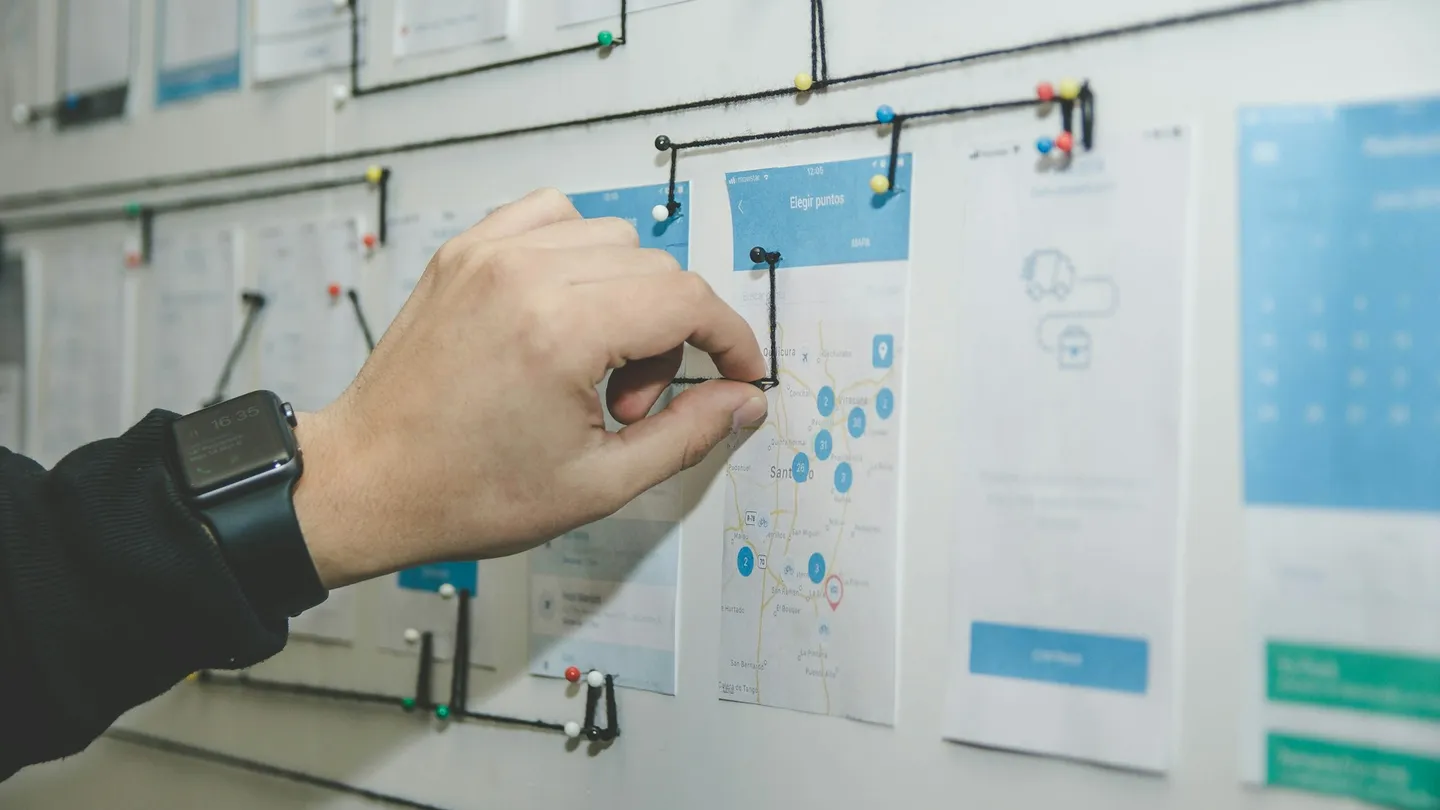
Illustrative cover photograph: Alvaro Reyes / Unsplash. Not a client engagement.
Give creative production a controlled route to publication
AI marketing automation works best when it has a bounded job: turn an approved brief and evidence-backed claims into draft variants, then route those variants through review. Publishing permission belongs in a separate step.
A model can produce twenty headlines before a marketing lead finishes a coffee. That is only useful if somebody can establish which claims they make, what evidence supports them and which version was approved.
More copy is not the same as more usable creative. Start with one campaign, one channel and a named reviewer. Measure the complete production cycle, including rejected drafts and corrections, rather than generation speed alone.
Freeze the brief and the claim library
Give each campaign a reference and brief version. Record the audience, market, language, channel, objective, landing page, offer dates, required qualifications and forbidden claims. Include actual channel limits rather than trusting the model to remember them.
Separate approved facts from creative direction. “Friendly and concise” is a style instruction. “Delivery within two working days” is a claim requiring evidence and conditions. The model must not strengthen “may help” into “will”, invent a customer endorsement or silently remove a qualification to fit a character limit.
The ASA and CAP guidance on AI advertising explains that existing advertising rules apply to issues such as misleading claims, testimonials and harmful AI-generated imagery. AI authorship does not make those checks disappear. This is UK guidance, not evidence of the requirements for a UAE campaign. Give each market its own review owner and obtain the relevant local advice.
For each claim, retain the precise approved wording, evidence reference, permitted market, qualification, approver and review date. Keep underlying confidential evidence in an approved repository, not in an unrestricted prompt.
Vary one creative choice at a time
Here is a fictional campaign for a document-review tool. Its only approved feature claim is: “Compare two document versions side by side.” The objective is to encourage eligible visitors to try a demonstration. No speed saving or error-reduction claim has been established.
Variant A leads with the feature: “Compare document versions side by side.” Variant B leads with the task: “Review what changed between two document versions.” Both can point to the same demonstrated function, subject to review of the complete ad and landing page.
“Cut review time in half” is a different claim. It needs its own evidence. “Never miss a change again” is not an energetic rewrite of either approved line.
Generate a small batch with stable IDs. Ask for the text, claim IDs used, required qualifications and any uncertainty. The model’s self-check is a drafting aid. It is not an approval. Save the brief version and generation settings needed to investigate problems later, without retaining unnecessary personal data.
Approve the actual asset that will run
Review factual accuracy before polishing tone. Then check brand, format, image rights, accessibility, market suitability and consistency with the landing page. For translations, use an appropriate language reviewer; literal accuracy alone may miss changes to the offer’s meaning.
Store approvals against an immutable version or content hash. A copy edit after approval produces a new version. Otherwise an approval record for “Variant B” can end up covering a headline nobody saw.
| Stage | Owner | Required evidence |
|---|---|---|
| Claim approval | Product or commercial owner | Supported wording and qualifications |
| Creative review | Marketing reviewer | Exact text and image version |
| Market review | Appropriate reviewer | Channel and jurisdiction checks |
| Publish authorisation | Campaign owner | Approved asset IDs, destination, dates and spend limit |
| Release check | Operator | Actual published asset matches authorisation |
Keep the drafting service unable to publish or change budgets. Give the publishing system only the approved package and separately authorised destination, timing and spend. If a landing page, price or offer date changes, return the affected assets to review. “Already approved” is a statement about a version, not a permanent exemption.
Measure accepted output and campaign outcomes separately
First measure the production process. In an illustrative trial, a manual campaign takes 120 minutes to draft and 60 to review: 180 minutes. An assisted version takes 35 minutes to prepare inputs and generate drafts, 65 to review and 20 to correct: 120 minutes. The saving is 60 minutes, or one third of the original total. These are fictional inputs, not reported client results or a forecast.
If the assisted workflow also needs 45 minutes of weekly library maintenance, allocate that effort across the campaigns it supports. Include licence and integration costs separately. A process can generate faster and still cost more to run.
For an illustrative campaign experiment, A receives 5,000 impressions and 100 clicks; B receives 5,000 impressions and 120 clicks. Their observed click-through rates are 2.0% and 2.4%. The difference is 0.4 percentage points, or 20% relative to A. That arithmetic does not establish a reliable winner or improved sales.
Define the primary outcome, assignment method, budget, duration and decision rule before launch. Keep the offer, audience and destination comparable when testing copy. Use the platform’s appropriate experiment tools and statistical analysis; ordinary ad delivery may allocate impressions unevenly. Track qualified outcomes and acquisition cost where those are the actual business objective. Avoid repeatedly checking a small sample and stopping when a preferred variant happens to lead.
Decide what stops the workflow
Pause release when evidence is missing, qualifications have been dropped, image rights are unclear, the landing page disagrees with the ad or approval points to an older version. Record the reason, send it to the responsible person and retain the rejected draft for a proportionate review period.
Once live, assign someone to withdraw or correct assets if an offer expires, a claim becomes unsupported or a complaint reveals a problem. Automation should make the affected variants easy to find through their claim IDs.
The useful automation is the traceable path from claim to published asset. Headline generation is one step inside it.
Use the claims-and-approvals sheet
The editable CSV includes the fictional brief, two candidate variants, an intentionally unsupported claim, approval fields and both worked calculations. All figures are plain values, not executable spreadsheet formulas. Blank rows let you add your own campaign.
Use it to run a dry rehearsal before connecting a publishing account. Generate, reject, revise and approve an example without placing an ad or submitting any live form. That rehearsal should expose whether the team can identify the exact asset authorised for release.
Download the editable worksheet (CSV) ↓
Frequently asked questions
Can approved copy be translated automatically?
It can be drafted automatically, but a new language version needs review for meaning, qualifications and market suitability. Keep its approval tied to the exact translated version.
Should every generated variant be published?
No. Publish only the variants that pass review and are included in the campaign owner’s authorisation. Keep rejected drafts out of the publishing package.
What if a claim changes after launch?
Use the claim reference to identify every affected asset. Have the campaign owner pause or replace those assets, review the landing page and approve the revised versions before resuming.
Sources checked 8 November 2026. Worksheets and worked examples are suggested working methods, not official standards or reported client results.