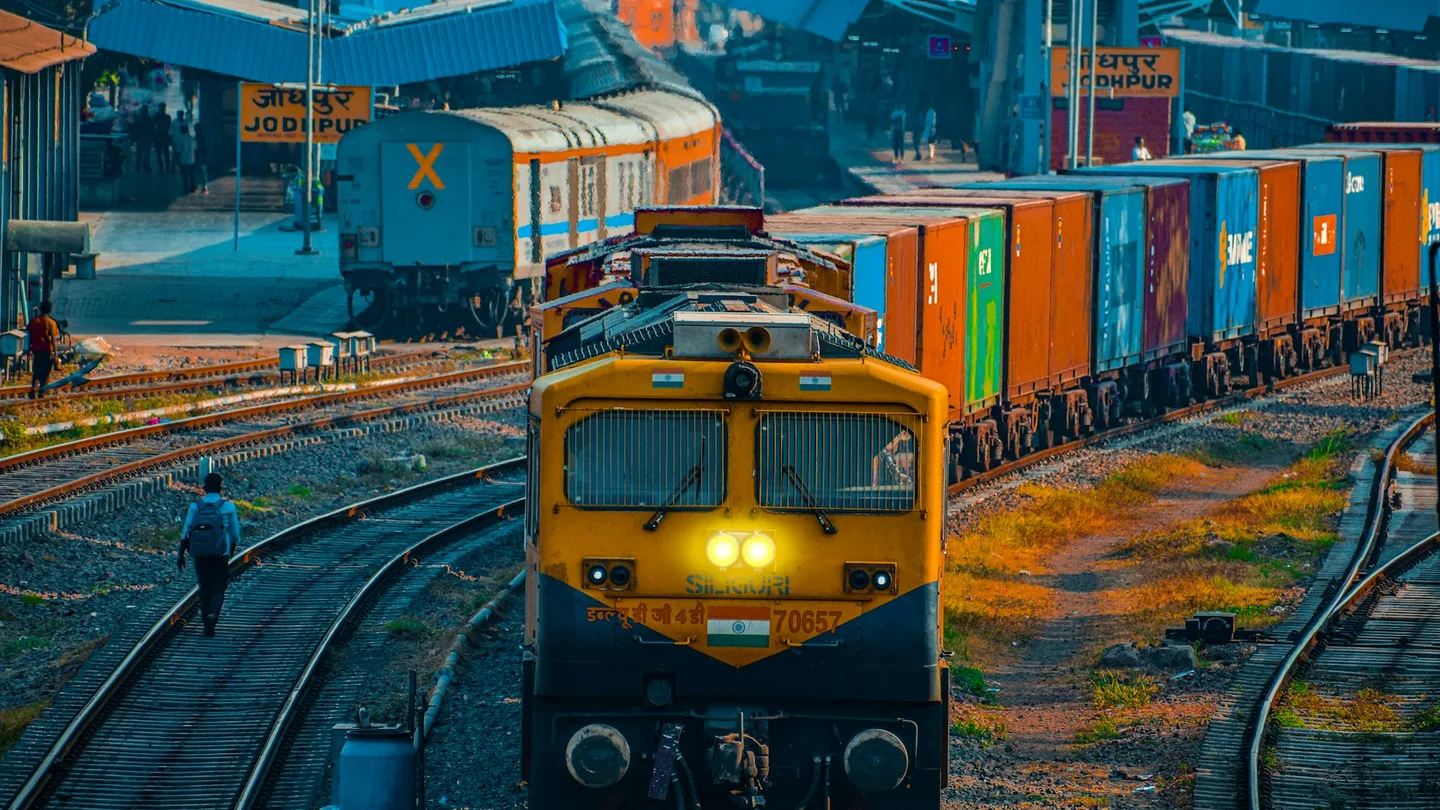
I get about 30 seconds with a minister before their phone lights up again. So I've got the explanation down to one image.
The short answer: digital public infrastructure (DPI) is the railway track: the shared national systems for identity, payments and data exchange. Digital public goods (DPGs) are the trains: open source software, data and standards that run on those rails and deliver actual services, such as civil registration or health records. DPGs are built on top of DPI, and some DPGs help lay the track itself.
Key facts:
- DPGs are defined in the UN Secretary-General's Roadmap for Digital Cooperation and recognised by the Digital Public Goods Alliance, set up in 2019
- DPI can be built with no DPGs at all, using proprietary software, as long as it follows open specifications (CDPI)
- Not every DPG can be used as a DPI building block (CDPI)
The railway analogy (and why it works)
Think about a national railway. The track, signals and stations are shared. Nobody builds a private railway line for every journey. That's DPI: identity to prove who you are, payments to move money, data exchange so systems can talk to each other.
The trains are what people actually use. One carries freight, another carries commuters. That's the DPG layer: a civil registration system that records births and deaths, a health information system, a social benefits platform. Each does a specific job, and all of them depend on the track underneath.
The point for a minister: get the track right once, and every new train is cheaper and faster to launch.
DPI vs DPG side by side
| Digital public infrastructure | Digital public goods | |
|---|---|---|
| What it is | Shared national systems | Open source products, data, AI models, standards and content |
| Layer | The rails | What runs on the rails |
| Owned by | Usually the state | Everyone: open licence, independent governance |
| Must be open source? | No, but must follow open specifications | Yes, by definition |
| Examples | Aadhaar, UPI, Pix, X-Road | OpenCRVS, DHIS2, MOSIP, OpenG2P |
| Lifespan | Tied to one country | Can predate or outlast any one country's DPI |
Where the analogy blurs
Here's the bit most explainers skip.
Some DPGs don't just run on the rails. They help lay them. CDPI points to MOSIP for identity and OpenG2P, OpenSPP and CoreMIS for government benefits as DPGs that countries use to build their DPI. A country that deploys MOSIP as its national ID platform is using a DPG as a piece of track.
So it's not a strict two-storey building. In practice:
- Foundational DPGs (identity, payments, data exchange, registries) can become part of a country's DPI
- Service DPGs (civil registration workflows, health records, education platforms) run on top of it
Even the DPGA's own DPG for DPI collection groups DPGs by four DPI use cases: ID, payments, data exchange and foundational registries.
My take: the railway picture is still the right starting point. Most DPGs are trains. A few are also track. If you understand that, you understand the whole relationship.

Do you need DPGs to build DPI?
No. CDPI is clear on this: a government can build DPI entirely with proprietary software and private vendors, as long as it sticks to minimalism, shared specifications, federation, inclusion, privacy and security.
It just usually costs more and takes longer.
That's why so many countries reach for DPGs. You start with software that's already been built, tested and deployed elsewhere. No licence fee, no vendor lock-in, and a community that keeps improving it. I've seen governments come to open source after years stuck with a proprietary vendor, some of them in formal disputes over unpaid bills. They're not converts to the philosophy. They're done being held to ransom. More in open source vs proprietary.
Is civil registration DPI or a DPG?
Both, depending on how you look at it.
OpenCRVS is by definition a DPG. It's open source and recognised by the DPGA. But the civil register it produces, the record of every birth and death, is foundational to a country's identity layer. You could argue it's DPI with a straight face.
ID and payments tend to get deployed first, because governments see the benefit immediately. Civil registration is quieter and more foundational, and the two often come hand in hand. See is civil registration part of DPI?
Why the distinction matters in practice
It sounds academic. It isn't.
- Procurement: DPI decisions are national and long-term. DPG decisions are closer to choosing a product, and should be easier to change.
- Funding: development funders often back the DPI layer as infrastructure, then fund specific DPG deployments as projects.
- Sequencing: if the identity rail isn't there, a civil registration DPG has less to plug into. Knowing which layer you're buying shapes the order you build in.
Frequently asked questions
Are DPI and DPGs the same thing? No. DPI is the shared national infrastructure. DPGs are open source products that run on it, or in some cases help build it.
Is MOSIP a DPI or a DPG? MOSIP is a DPG. When a country deploys it as its national ID platform, it becomes part of that country's DPI.
Can DPI be proprietary? Yes, as long as it follows open specifications and is interoperable. It usually costs more and risks lock-in.
Is Aadhaar a DPG? No. Aadhaar is India's DPI for identity. It isn't open source software that other countries can freely adopt.
Sources
- DPG and DPI, Centre for Digital Public Infrastructure
- DPGs for DPI collection, Digital Public Goods Alliance
Working out which layer you're actually buying? Let's talk.