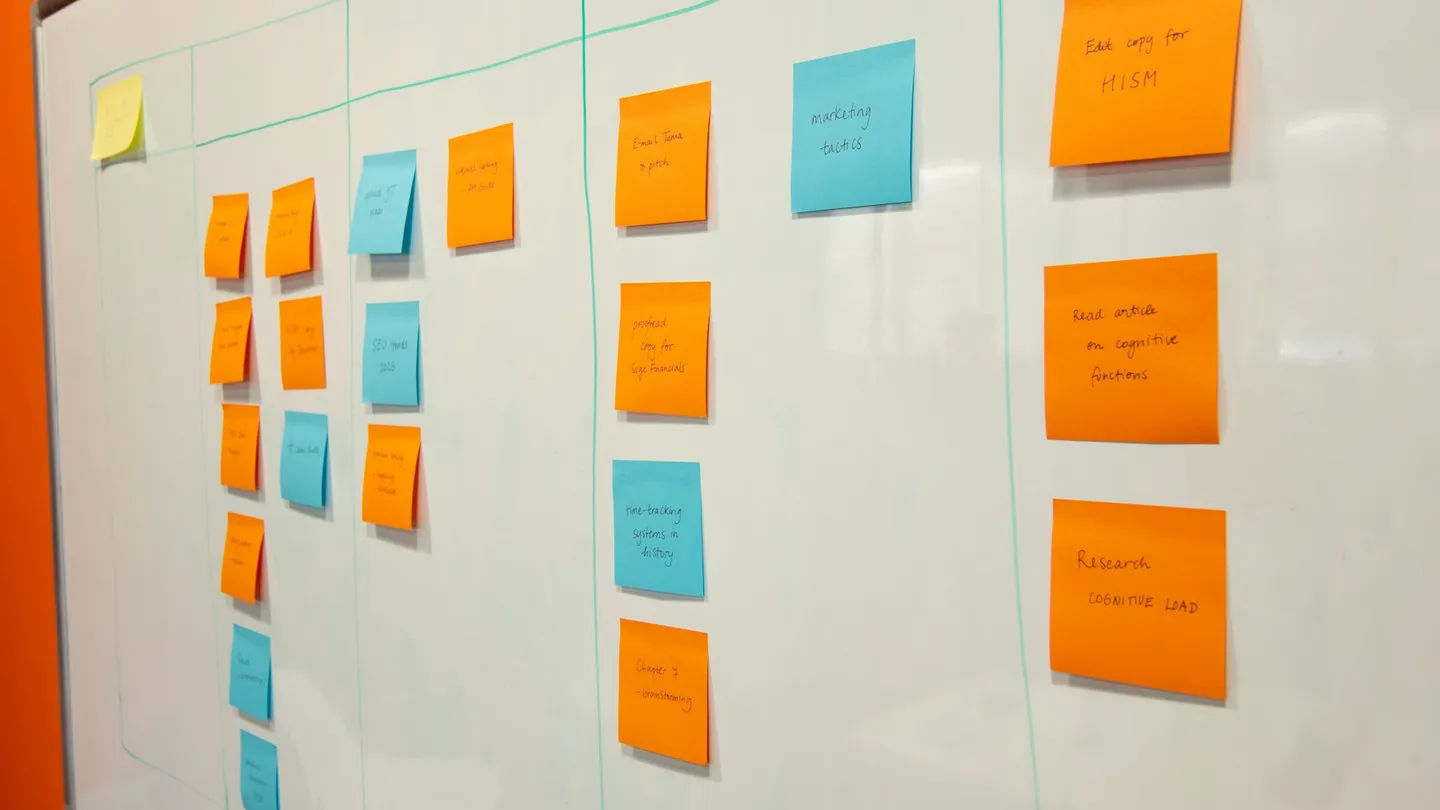
Cover photo: Paymo / Unsplash. Illustrative photograph, not a client project.
Map the handoff, not just the task
“Interface complete” sounds reassuring until the receiving team discovers it means code written, rather than available for testing.
Programme dependency mapping makes these handoffs explicit. It connects the output one team produces to the work another team cannot start or finish without it. The useful unit is an accepted deliverable, with a date and a receiving owner.
A RAID log can record the dependency. The map shows what happens further along the chain if it moves. The consequence rarely stops at the first team waiting.
GovS 002, section 7.2.4 calls for dependencies between activities and work components to be defined in plans. The method below is a suggested practical implementation, not an official government template.
Write one record for each accepted handoff
Start at the milestone you need to protect and work backwards. Ask the receiving team what must exist before its activity can proceed. Then ask the producing team whether that output and date are actually in its plan.
Record a stable ID, producer, consumer, deliverable, required acceptance time, forecast acceptance time, evidence and downstream activity. Add the working calendar, predecessor IDs and the decision owner for a missed date. “Supplier” is not a sufficiently specific owner; name the person who can commit its work.
Keep required and forecast dates separate. Overwriting the requirement with each new forecast conceals the gap you need to manage.
Acceptance evidence might be a jointly approved interface contract, a successful test against the agreed version, or a signed operational procedure. The producer marking an item complete should not silently stand in for the consumer accepting it.
A London-to-Dubai worked example
This example is fictional. Both teams work Monday to Friday, with no holidays during the week. The London supplier works 09:00–17:00 UTC; the Dubai test team works 09:00–17:00 Gulf Standard Time, UTC+4. These are agreed team calendars, not assumptions about all employers in either country.
D1 is an accepted test interface, required Monday 9 November 2026 at 12:00 UTC, which is 16:00 in Dubai. D2 is a full eight-hour integration test, scheduled Tuesday from 09:00 to 17:00 Dubai time. D3 is a four-hour operational rehearsal, scheduled Wednesday from 09:00 to 13:00 Dubai time. Each activity starts only after its predecessor has been accepted.
Now move D1 acceptance to Tuesday at 14:00 UTC, or 18:00 Dubai time. The receiving team has finished for the day. D2 moves to Wednesday; D3 moves to Thursday morning. A Wednesday 13:00 Dubai readiness review can no longer receive the completed rehearsal evidence. With no spare time or approved alternate evidence in this simple chain, that review moves by one working day.
The elapsed delay to D1 is 26 hours. The downstream effect is governed by calendars and sequence, not by adding 26 hours to every milestone. A larger network needs resource and critical-path analysis; this three-link example is deliberately small.
Choose a response before the window closes
At Monday’s checkpoint, the delivery lead can ask whether the delay is recoverable before Dubai’s Tuesday start. If it is not, options include moving the review or using an already validated substitute interface for part of the testing. A substitute is only useful if the test owner confirms what it proves and what must be repeated against the real interface.
Do not assume overtime, shorter tests or waived acceptance. Each changes cost, coverage or operational risk. Record the authorised choice, the remaining exposure and a decision deadline that leaves time to act.
The worksheet includes this dependency chain and a blank row. Replace the illustrative role owners with named people and link evidence stored in your own controlled repository. It contains no scheduling engine or automatic critical-path calculation.
Review changes rather than redraw everything
A short dependency review should compare forecasts with required dates, examine unaccepted deliveries and resolve disputed commitments. Start with the dependencies affecting the next decision window. Ask the producer and consumer together; two separate green reports can describe incompatible expectations.
Keep a closed dependency’s actual acceptance time and evidence. If a replacement deliverable changes the contract, version the record instead of erasing the previous agreement. Link risks and issues back to the dependency ID so the same delay is not discussed as three unrelated problems.
The useful map is small enough that someone can trace the chain and say what decision is needed today. A wall of arrows without calendars, owners or acceptance evidence is mostly decoration.
Practical questions
Does every task need to appear on the programme map?
No. Keep detailed tasks in the workstream plan. Bring a handoff into the programme view when it crosses an ownership boundary, constrains an important milestone or needs coordination outside the team. Retain the link to its detailed schedule.
Can a dependency have two owners?
Name a producer responsible for supplying the output and a consumer responsible for accepting it. Also name the person who resolves a disputed commitment. Shared participation is useful; an unnamed collective owner is not.
What if a supplier will not commit to the required date?
Show the forecast as unconfirmed and expose the consequence. Ask for a dated response and evaluate alternatives before the decision window closes. Do not present the required date as a supplier commitment merely because it is in your plan.
Use the worksheet
Download the editable worksheet (CSV) ↓
Open the CSV in your spreadsheet application, replace the illustrative entries and add rows for your programme. It contains plain values, no formulas or macros. Keep evidence references in the sheet and sensitive supporting material in your own controlled systems. Nothing is submitted through this download.
Reviewed 8 November 2026. Examples, figures and working methods are illustrative editorial material, not measured client results, professional certification or a substitute for your organisation’s required approvals.